
Introduction: A Market in Motion
For half a century, the deck boot market was a one-brand town. If you fished, you wore the brown-and-yellow boots from Xtratuf. They were the undisputed standard on commercial fishing vessels from Kodiak to Cape Cod, earning their reputation honestly in the world’s most brutal marine conditions. As recently as a decade ago, walking onto a dock in Alaska wearing anything else would earn you sideways glances and unsolicited advice.
That world is gone. Today’s deck boot market is more fragmented, more competitive, and more interesting than at any point in its history. The legacy standard-bearer has seen its reputation erode as manufacturing moved overseas and quality complaints piled up. New challengers—Grundens, Huk, Aftco—have carved out significant niches with specialized performance features. And a wave of direct-to-consumer brands, led by companies like Trudave Gear, have disrupted the pricing structure entirely by delivering premium materials without the traditional retail markup.
This article is a clear-eyed look at the 2026 deck boot landscape. We’ll examine the major players, their strengths and weaknesses, and where Trudave’s WaveLock and DeckFlow boots fit into the hierarchy. The goal isn’t to crown a winner—no single boot is right for every angler—but to give you the honest, comparative information you need to choose the right boot for your boat, your budget, and your body of work.
Part 1: The Legacy Leader in Transition—Xtratuf
Xtratuf’s story is one of genuine heritage. The brand was founded in 1951 and for decades produced boots that commercial fishermen trusted with their lives. Made with triple-dipped latex neoprene, the original Legacy Boot created a barrier between feet and “all kinds of acids and corrosives you’ll find on a commercial fishing vessel.” The brown-and-yellow colorway became so iconic that a pair worn aboard the Alaska Ocean factory trawler now sits in the Smithsonian.
But manufacturing moved overseas—the exact timeline is debated, but most forum consensus points to the late 2000s or early 2010s—and quality, by widespread user testimony, declined. Forum threads are filled with complaints of cracking at the toe crease within months, soles delaminating, and a general sense that the boot was no longer the five-season workhorse it had been. Meanwhile, prices rose significantly. One prominent fishing forum documented a 60% price increase in a single year. Anglers were being asked to pay more for a product that, by broad agreement, was delivering less.
In 2026, Xtratuf has attempted to bridge the gap between its commercial legacy and a broader lifestyle audience. The Ankle Deck Boot (ADB) Pro incorporates elements of the original Legacy Boot design, is triple-dipped for a tough waterproof exterior, and is engineered for all-day comfort. The brand now serves a diversified customer base, with roughly half its customers being male adults. But the question among serious anglers persists: is this still a commercial-grade work boot, or is it becoming a lifestyle brand with a fishing heritage?
Where Xtratuf Still Excels: The Legacy Boot, for those who find a good pair, remains one of the most comfortable and flexible deck boots available. The neoprene construction provides excellent chemical resistance and insulation. For anglers who have worn Xtratufs for 20 years, the familiarity and fit are hard to abandon.
Where Xtratuf Has Vulnerabilities: Quality consistency. The gap between a “good pair” and a “bad pair” is too wide. The premium price point (130to150 for ankle models) is increasingly hard to justify against direct-to-consumer alternatives offering comparable materials and construction at substantially lower prices.
Part 2: The Credible Contender—Grundens
If any brand has stepped into the void left by Xtratuf’s quality struggles, it’s Grundens. Founded in Sweden in 1911 and now deeply rooted in the Pacific Northwest commercial fishing community, Grundens has built a reputation for heavy-duty, durable gear designed for extreme conditions. Their 2026 Deck-Boss collection represents a serious commitment to the performance deck boot market.
The Deck-Boss boots are available in multiple heights and feature a razor-cut siped outsole for maximum wet traction—a technology very similar to what Trudave deploys in the WaveLock’s micro-channel siping. The upper is a high-content natural rubber compound with reinforced stress zones to prevent cracking. Inside, a moisture-wicking antimicrobial insole liner addresses the sweat issue inherent in any rubber boot. These are boots designed by people who understand commercial fishing.
Where Grundens Excels: Durability and brand trust among professional fishermen. Grundens gear is worn by crabbers in the Bering Sea and longliners in the North Atlantic. The Deck-Boss is a boot you can buy with confidence that it will survive brutal conditions.
Where Grundens Has Vulnerabilities: Price. Grundens boots command a premium, often in the 140to180 range. They also have a more traditional, utilitarian aesthetic that may not appeal to recreational anglers looking for a boot that transitions from boat to dock to restaurant.
Part 3: The Recreational Specialists—Huk and Aftco
Huk and Aftco have taken a different approach. Rather than building boots for commercial fishermen and hoping recreational anglers buy them, these brands have designed specifically for the recreational market—and it shows in the features they emphasize.
Huk’s Rogue Wave collection is built for anglers who live on wet decks and slick docks. The boots feature a Grip X Slice outsole with microchannel traction, durable neoprene and rubber construction for waterproof protection, and a breathable mesh liner for all-day comfort in a slip-on design. The emphasis is on performance, but also on the look and feel of the boot—sleek, modern, and designed to be worn beyond the boat.
Aftco’s deck boots emphasize eco-friendliness and technical performance. They feature a quick-drying inner neoprene liner, a compression-molded antimicrobial insole for comfort, and a design that prioritizes lightweight agility over heavy-duty protection. These are boots for the inshore angler, the flats fisherman, the weekend warrior.
Where Huk and Aftco Excel: Comfort, breathability, and recreational-specific design. These boots feel more like athletic shoes than traditional rubber boots. They’re ideal for warm-weather fishing and anglers who prioritize all-day wearability.
Where Huk and Aftco Have Vulnerabilities: They are not built for commercial-grade abuse. The lighter construction that makes them so comfortable in warm weather leaves them under-protected for the diesel, ice, and heavy gear of a working waterfront. They are specialists in the recreational niche, not all-weather warriors.
Part 4: The Direct-to-Consumer Disruptors—Trudave Gear and TIDEWE
The most significant structural change in the deck boot market over the past five years has been the rise of direct-to-consumer brands. By selling directly to anglers through their own websites, these companies eliminate the wholesale distributor, the retail store markup, and the massive marketing budgets that legacy brands must cover. The savings go into materials and construction, allowing DTC brands to offer vulcanized natural rubber, aggressive siping, EVA midsoles, and sealed waterproof construction at prices that dramatically undercut the legacy competition.
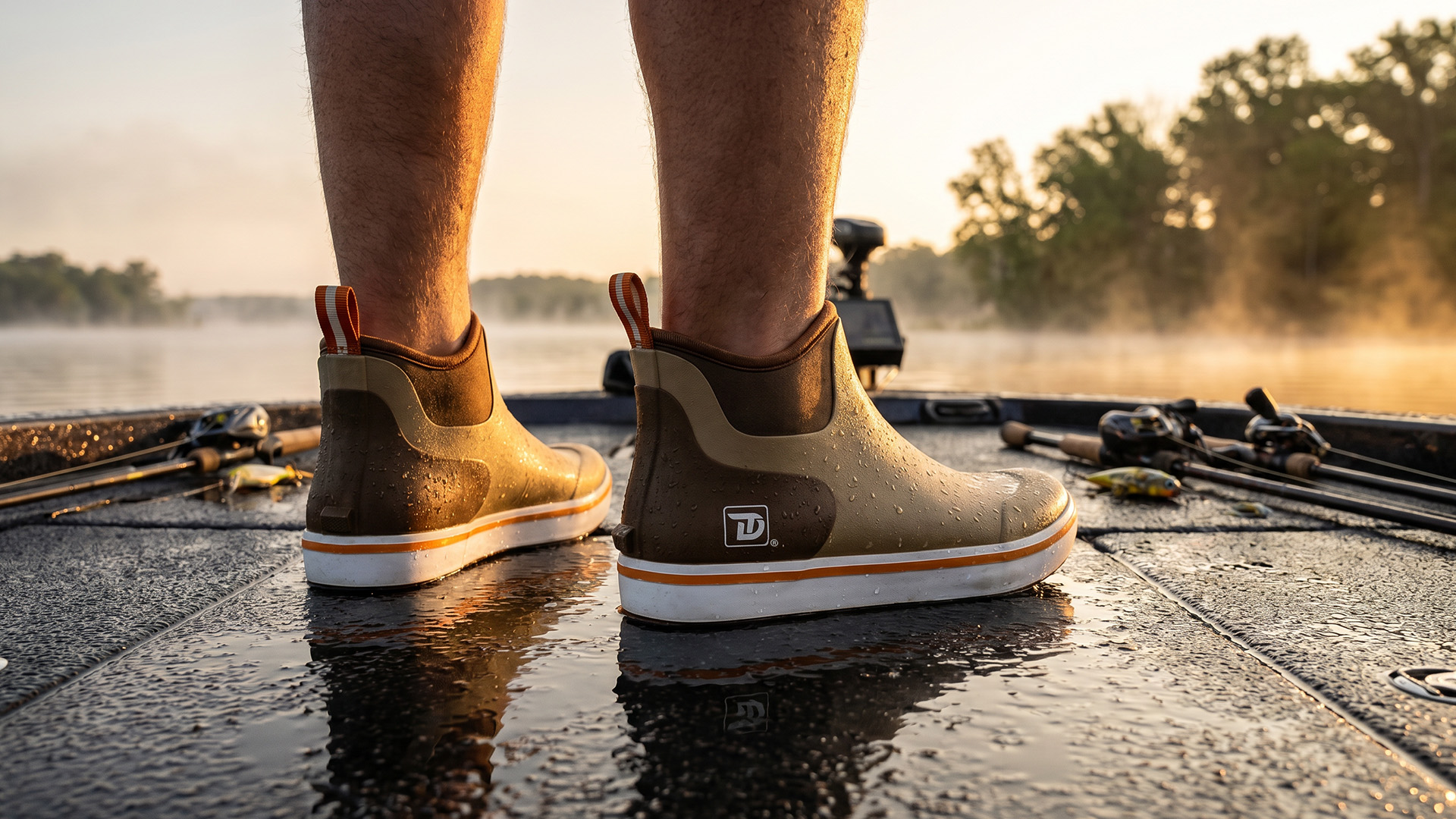
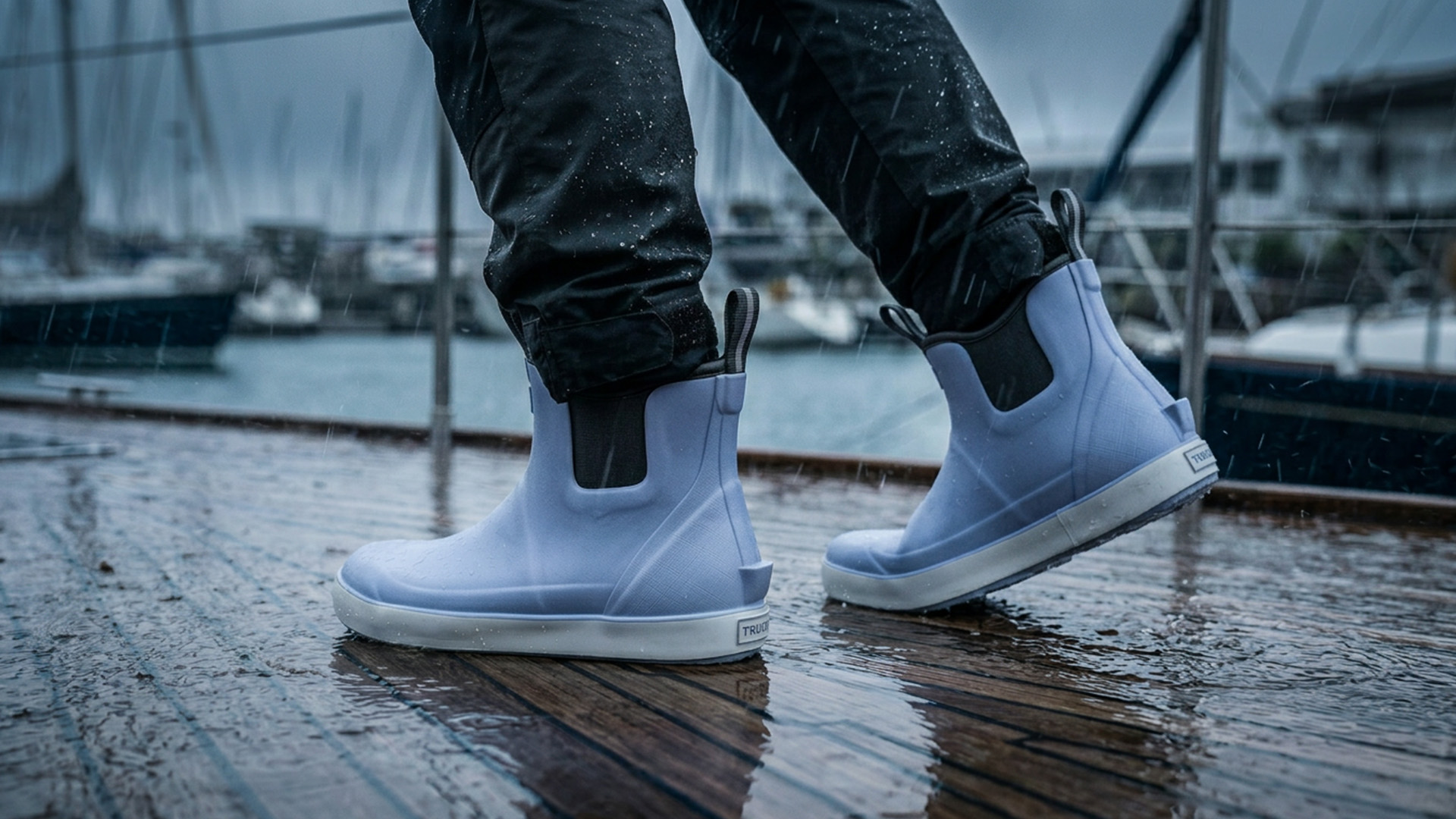
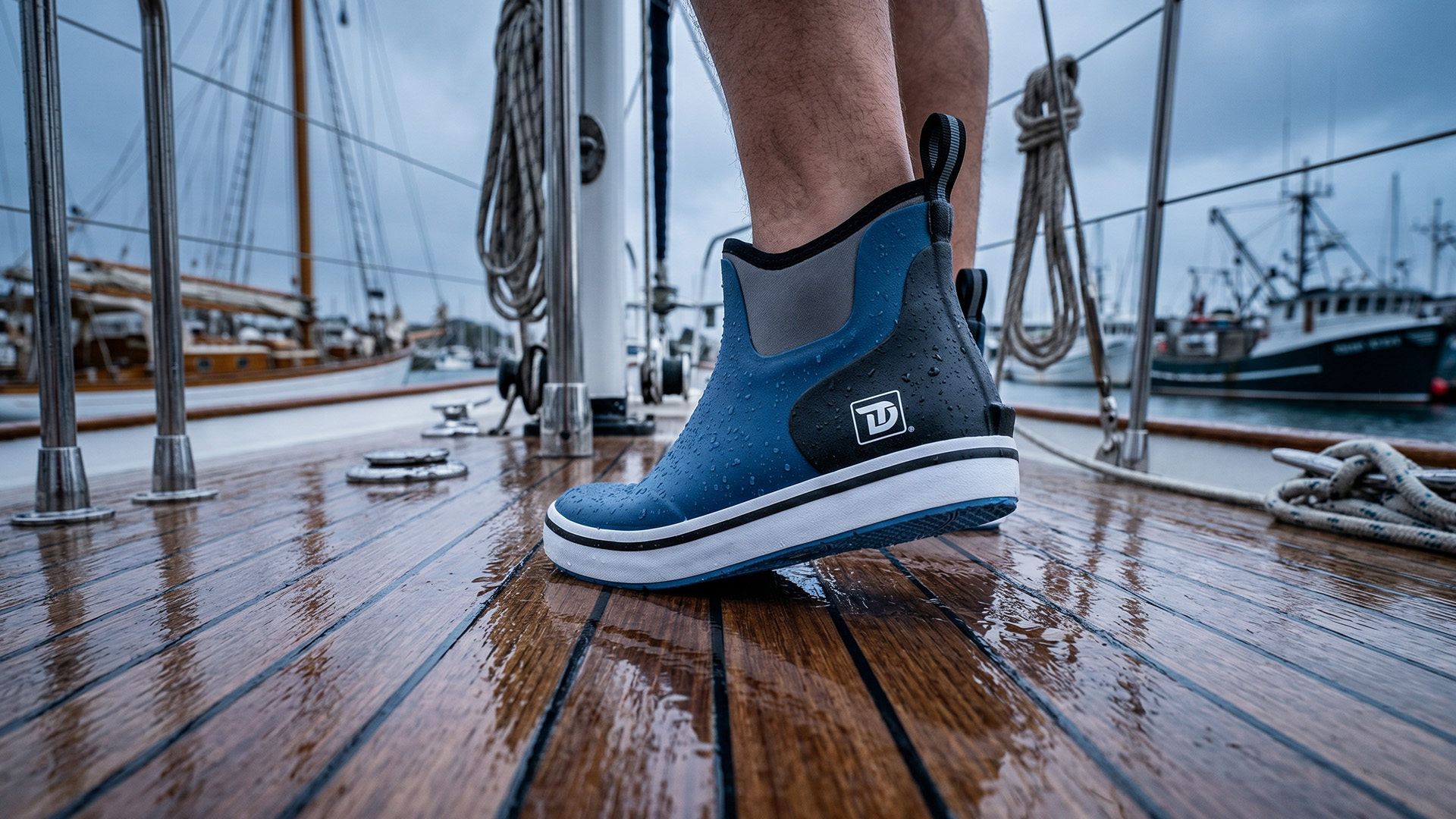
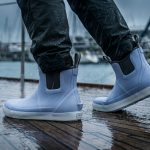
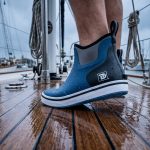
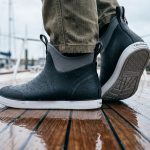
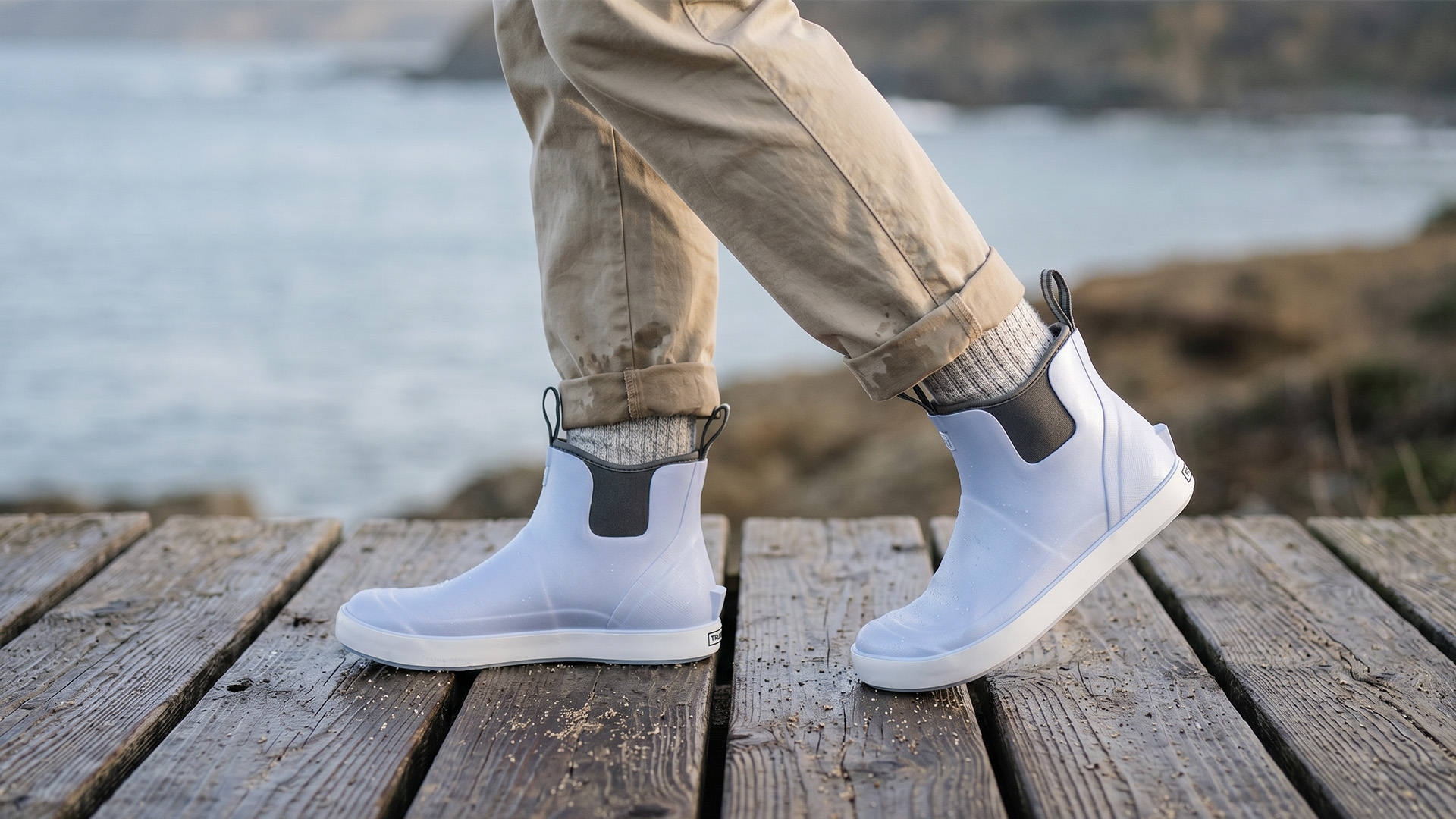
Trudave Gear has emerged as one of the leaders in this space. Their WaveLock and DeckFlow deck boots are built from premium natural rubber—not the petroleum-based PVC found in budget boots—with vulcanized sealed construction that prevents delamination. The WaveLock features an exclusive micro-channel siped outsole for wet-surface traction, thermal insulation for cold mornings, flexible side panels for easy on/off, and a reinforced toe shell. The DeckFlow adds a women’s-specific last and a non-marking, breathable design for warm-weather versatility.
In independent testing, Trudave’s deck boots have been compared favorably to the legacy competition. One comprehensive review noted that they “masterfully execute the trifecta of offshore footwear: the optimal mid-calf height, a ruthlessly aggressive siped outsole that refuses to slip, and a zero-steel-shank architecture that keeps you incredibly light on your feet.” Another review placed Trudave alongside TIDEWE as a top performer in the value-engineering category, noting that both brands “punch above their weight, offering 90% of the performance at half the cost.”
TIDEWE, another DTC brand, has also gained traction with neoprene-insulated deck boots that target the same cold-weather, wet-deck market as the WaveLock. Both brands are capitalizing on the same insight: that anglers are increasingly willing to buy boots online, compare materials and prices across brands, and choose the product that delivers the best value rather than the most familiar logo.
Where Trudave Excels: Value engineering. Vulcanized natural rubber, micro-channel siping, and EVA midsole comfort at direct-to-consumer prices that often undercut legacy brands by 40% to 60%. The WaveLock’s insulation and traction are standout features for cold-water and variable-weather anglers. The DeckFlow’s women’s-specific fit fills a genuine gap in a market that has historically ignored female anglers.
Where Trudave Has Vulnerabilities: As a newer brand, Trudave doesn’t have the multi-decade track record of a Grundens or Xtratuf. Some anglers prefer the feel and familiarity of a legacy boot. And while the direct-to-consumer model offers genuine value, it requires anglers to buy without trying on—a hurdle that detailed size charts and satisfaction guarantees are designed to address.
Part 5: The Feature-by-Feature Comparison
| Feature | Trudave WaveLock | Xtratuf Ankle Deck Boot | Grundens Deck-Boss | Huk Rogue Wave |
|---|---|---|---|---|
| Waterproofing | Vulcanized natural rubber, sealed seams | Triple-dipped latex neoprene | High-content natural rubber, reinforced seams | Neoprene & rubber, sealed construction |
| Traction | Micro-channel siping | Chevron outsole | Razor-cut siped outsole | Grip X Slice microchannel |
| Insulation | Thermal lining (WaveLock) | Uninsulated (varies by model) | Uninsulated (varies by model) | Uninsulated, breathable mesh |
| Comfort | EVA midsole, cushioned insole | Flexible neoprene construction | Antimicrobial insole liner | Breathable mesh liner |
| Easy On/Off | Flexible side panels, heel tab | Pull tabs | Pull tabs | Slip-on design |
| Price Range | 70–100 (DTC) | 130–150 (Retail) | 140–180 (Retail) | 80–120 (Retail) |
The pattern is clear: Trudave delivers the same premium materials and construction methods—vulcanized natural rubber, siped outsoles, cushioned midsoles, sealed waterproofing—as boots costing 40% to 80% more. The difference isn’t in what the boot is made of. It’s in how it’s sold.
Part 6: What Real Anglers Are Saying Across Brands
The best information about any deck boot comes from the people who wear it when conditions turn ugly. Across Trustpilot, fishing forums, and independent reviews, patterns emerge for each brand.
Xtratuf users continue to praise the fit and flexibility of the Legacy Boot but express frustration with durability. One forum user summarized a common sentiment: “I’ve worn Xtratufs for 15 years. When they’re good, they’re great. But I’ve had two pairs in a row crack at the toe crease in under six months. I’m looking for alternatives.”
Grundens users are generally positive about durability. A commercial fisherman in the Bering Sea reported that his Deck-Boss boots “took a full season of crab fishing without a single leak or crack.” The price is the most common complaint.
Huk and Aftco users praise the comfort and lightweight feel but acknowledge the trade-off in durability. “Perfect for summer inshore fishing,” one reviewer wrote of the Huk Rogue Wave, “but I wouldn’t wear them on a commercial boat.”
Trudave users consistently cite value, waterproofing, and traction as strengths. On Trustpilot, where Trudave maintains a “Great” rating of 4.1 out of 5, a farmer who uses the boots daily wrote: “It has been about two months now and these boots are still going strong and keeping our feet protected.” A charter captain who tested the WaveLock through a full Alaskan season reported: “They never once slipped, even when the deck was slimed with halibut and cod.” The most common critique is the sizing: the boots run slightly large by design to accommodate thick socks, which requires first-time buyers to pay close attention to the size chart.
Part 7: The Decision Framework for 2026
Given the current landscape, here’s how to think about choosing a deck boot in 2026.
Choose Xtratuf if: You’ve worn them for 20 years, you know your size, you’ve had good luck with recent pairs, and the fit is worth the price and the quality roulette. The Legacy Boot remains, when well-made, one of the most comfortable deck boots on the market.
Choose Grundens if: You’re a commercial fisherman or serious offshore angler who needs a boot that will survive extreme abuse. The Deck-Boss is expensive, but it’s built for people whose livelihoods depend on their gear.
Choose Huk or Aftco if: You’re a recreational angler in warm climates who prioritizes lightweight comfort and breathability over heavy-duty durability. These are excellent boots for inshore fishing, flats poling, and casual boating.
Choose Trudave if: You want premium materials—vulcanized natural rubber, aggressive siping, cushioned EVA midsoles—at a price that reflects the boot rather than the brand name. You’re willing to buy direct-to-consumer, measure your foot, and trust the size chart. You fish in variable conditions and want a boot that handles both cold mornings and warm afternoons without compromise. And you appreciate that in 2026, the best value in deck boots no longer comes from the brand that dominated the 20th century—it comes from the brands that are rethinking how fishing gear should be made and sold.
Conclusion: A Better Market for Anglers
The fragmentation of the deck boot market is, on balance, a good thing for the people who actually wear the boots. When Xtratuf was the only serious option, there was no incentive to improve quality or control prices. Today, with Grundens, Huk, Aftco, Trudave, TIDEWE, and others all competing for the same anglers, the pressure is on every brand to deliver better materials, better construction, and better value.
Trudave Gear has carved out a distinct position in this landscape: premium vulcanized natural rubber, aggressive micro-channel siping, and EVA midsole comfort at honest, direct-to-consumer prices. The WaveLock for cold mornings, wet decks, and all-weather warriors. The DeckFlow for warm days, precise women’s fit, and dockside versatility. Together, they represent the most disruptive value proposition in the 2026 deck boot market—not because they’re the cheapest, but because they deliver the materials and performance of boots costing far more, without the logo tax.
The right boot is the one that keeps you dry, keeps you upright, and keeps you fishing. For a growing number of anglers, that boot says Trudave on the side.
To explore the complete Trudave Gear deck boot lineup and see how they compare for yourself, visit trudavegear.com.