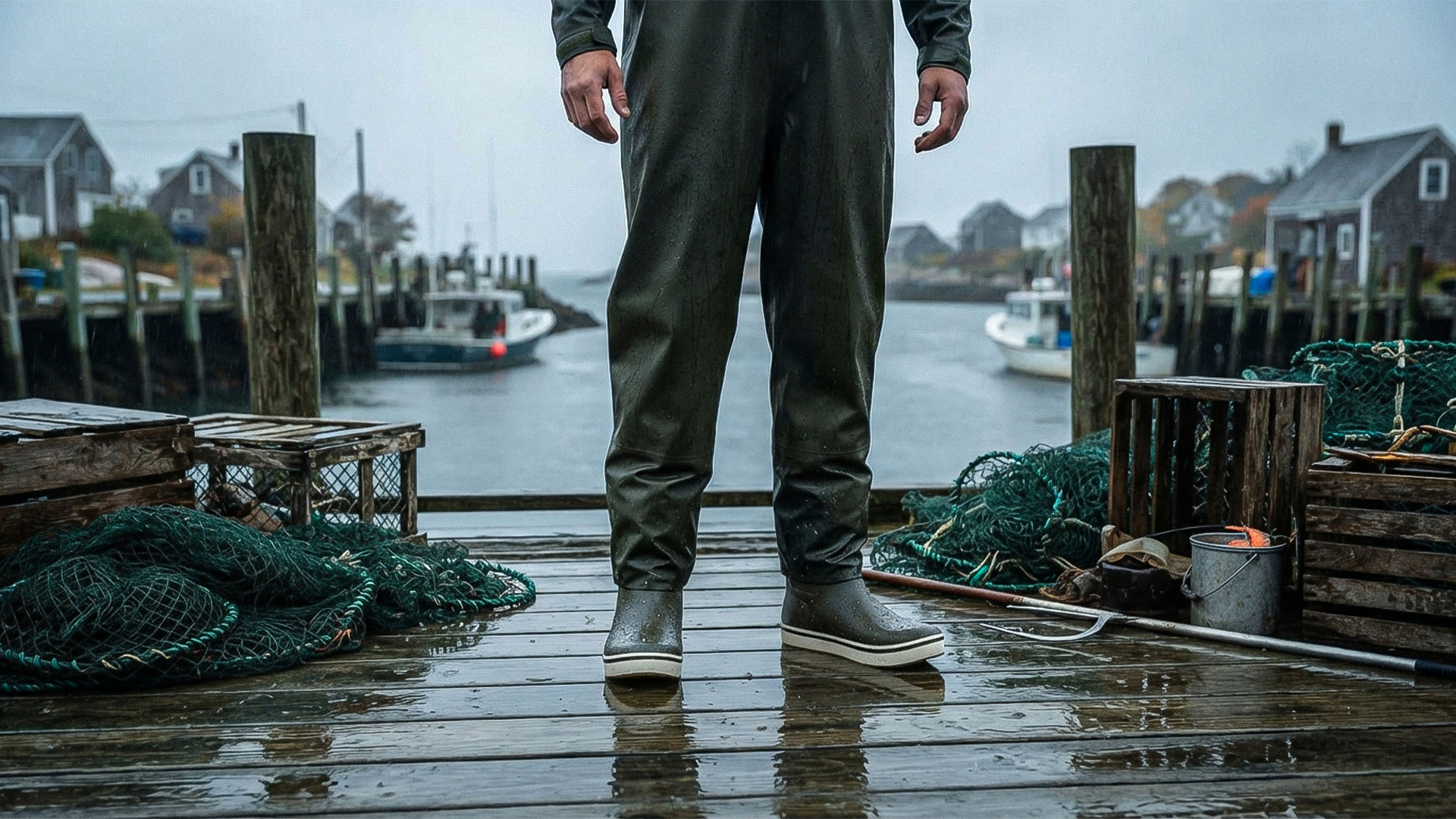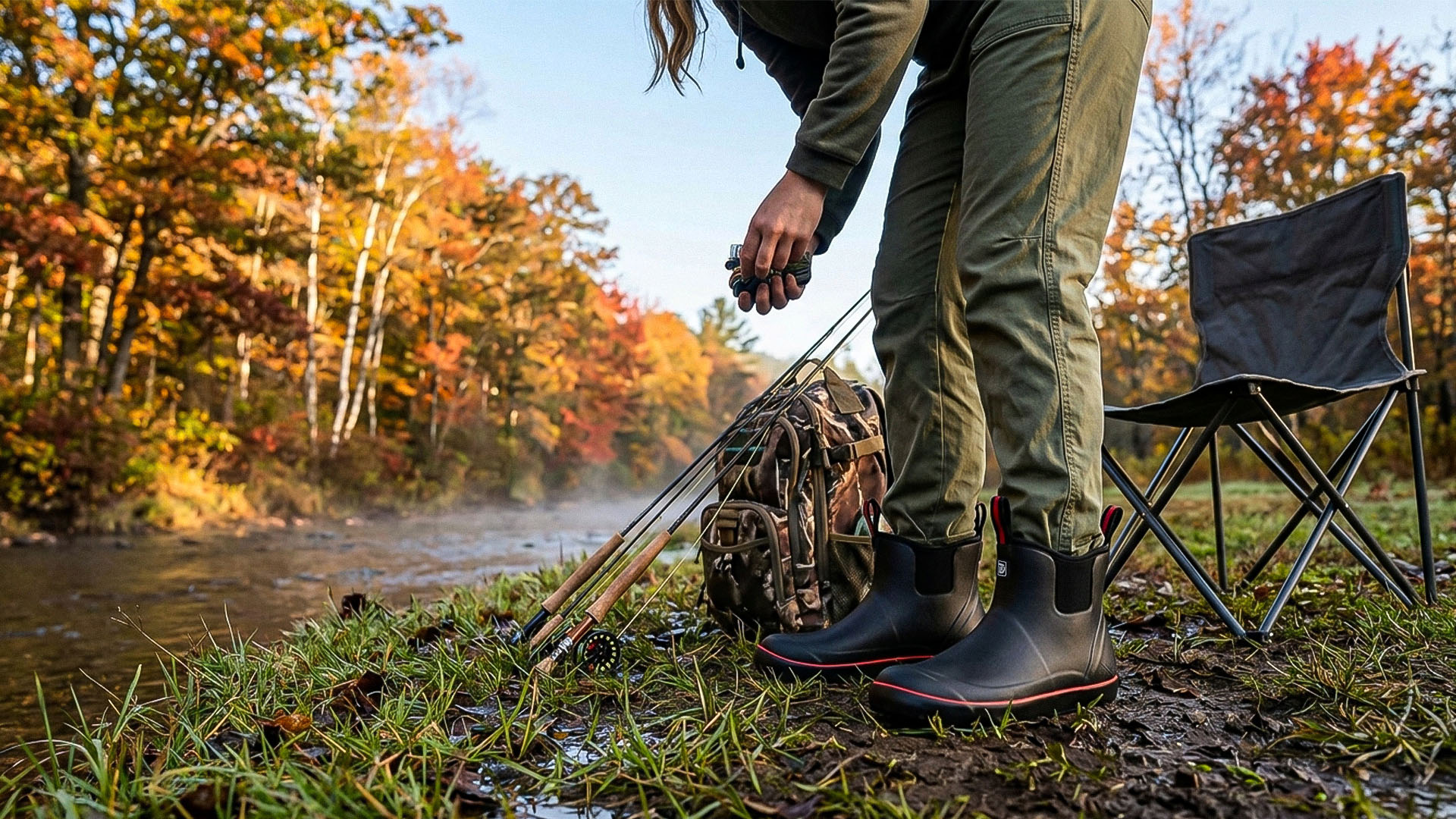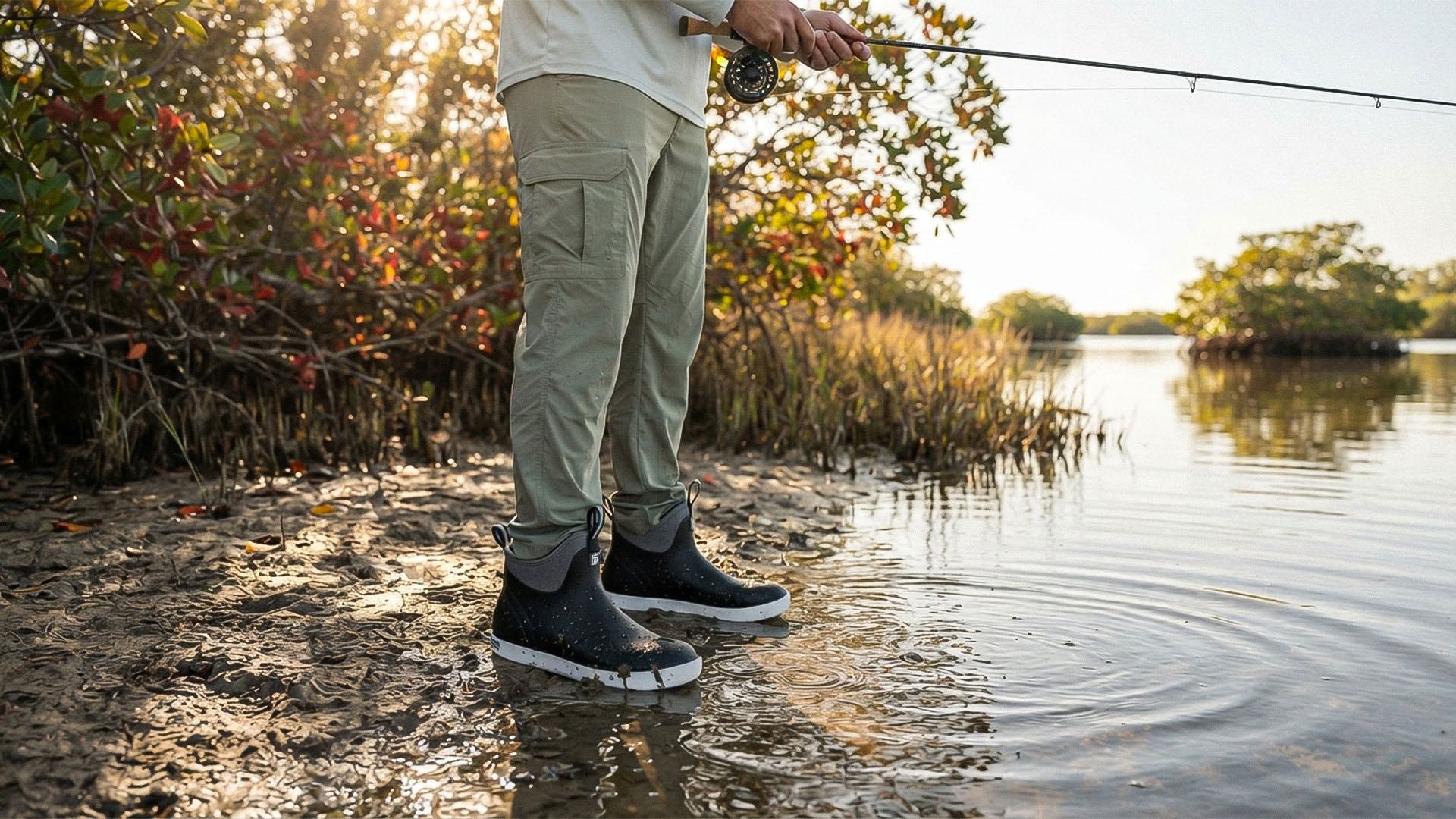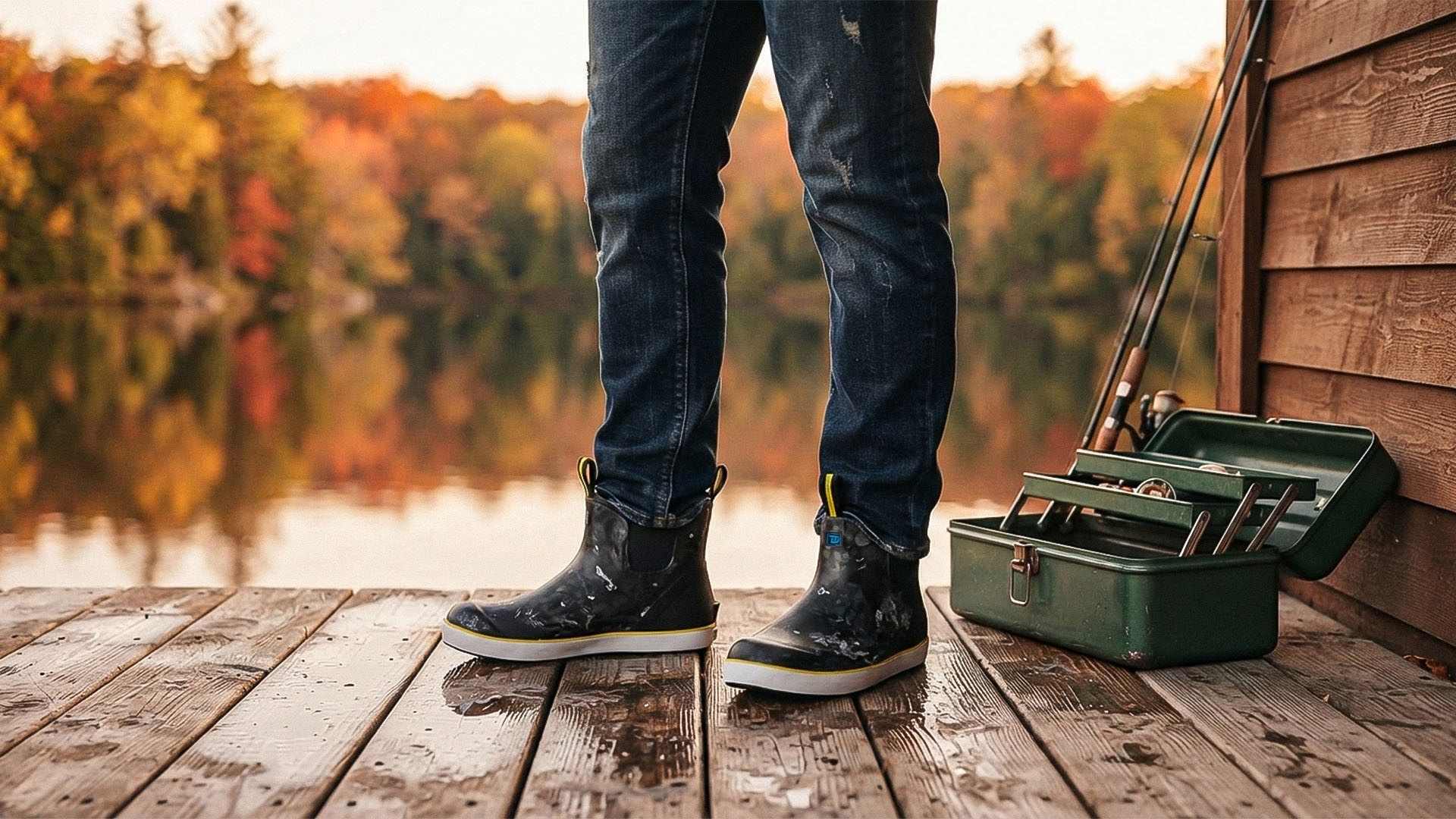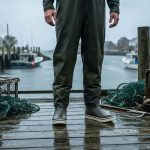
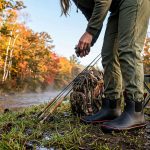
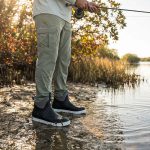
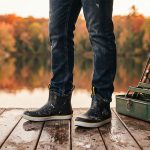
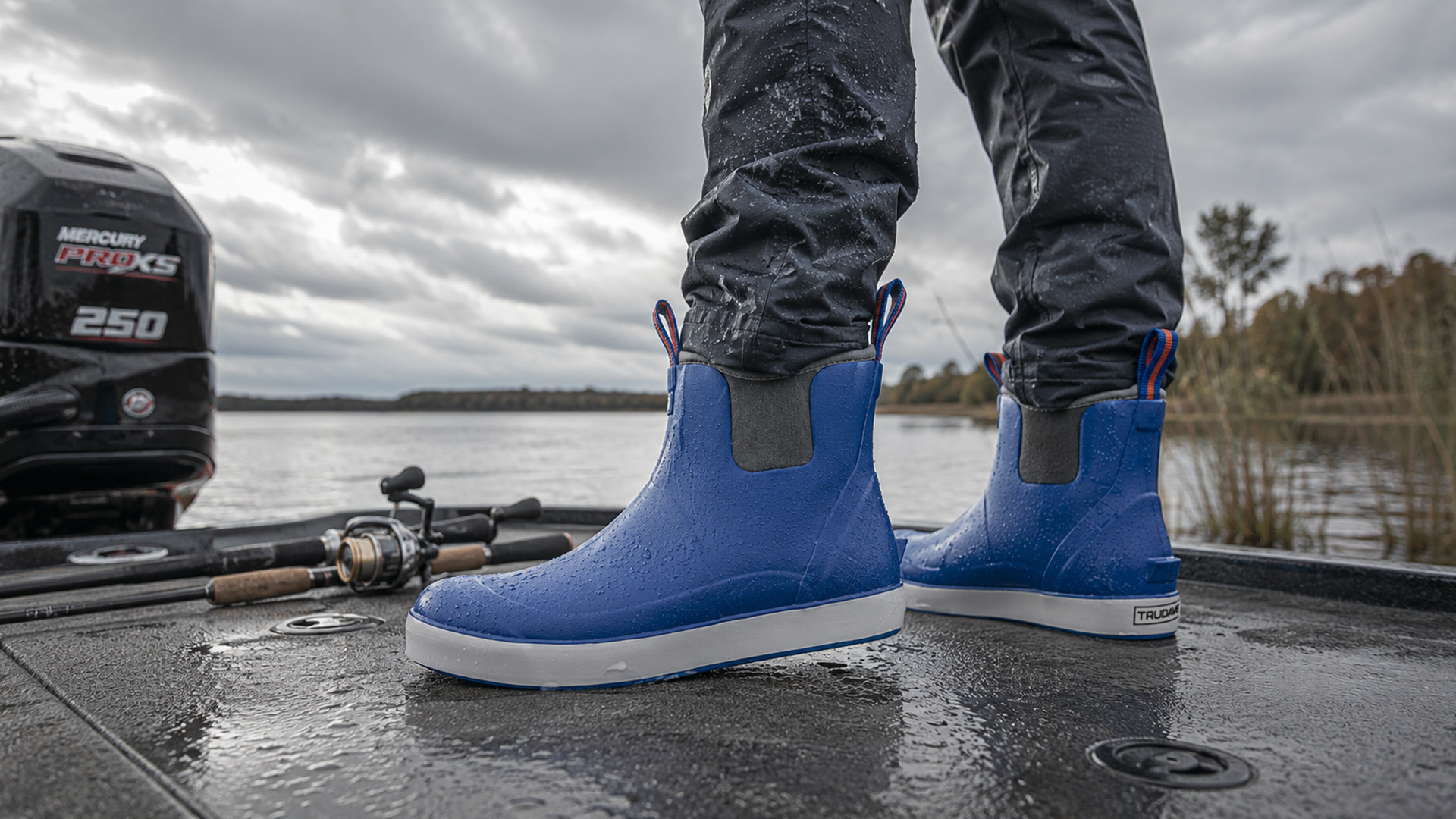
Fly fishing from drift boats and rafts creates a unique footwear challenge — you need deck boots for the boat and wading boots for the water, and the transition between them happens constantly. Here’s the complete Trudave guide for 2025.
Fly fishing from a drift boat is one of the most enjoyable ways to access trout water — and one of the most footwear-complicated.
You board the drift boat at the launch in wading boots. You fish from the boat, kneeling on the frame, leaning over the gunnel, repositioning on the deck. You pull over at a run that demands wading access. You step out of the boat into the river in your wading boots, wade the run, return to the boat, take your wading boots off, put something else on your feet to continue floating. You arrive at the takeout and repeat the process in reverse.
The “something else” in that sequence is a question that most fly fishing content has never adequately answered. You can’t stay in wading boots on a wooden drift boat drift — felt soles contaminate waterways with invasive species when dragged across dry wood, and studded rubber soles damage the wooden floors of classic wooden drift boats. You can’t go barefoot on a drift boat all day without foot fatigue and the occasional painful encounter with fly boxes and anchor hardware. And most rubber deck boots are either overkill for what you need or don’t pack flat enough to fit in the boat’s dry storage.
This guide is written for fly anglers who fish from drift boats, rubber rafts, inflatable pontoons, and the various floating platforms that western and northeastern river fishing relies on — and who need a practical, specific answer to the footwear question that every guided drift trip creates.
The Drift Boat Footwear Problem in Detail
Why Wading Boots Don’t Work on Drift Boats
Wading boots serve their purpose: they grip wet river rock, they protect the ankle and foot during wade fishing, and they work with neoprene waders or wet-wading gear to keep feet comfortable in cold river water.
None of these properties are relevant on a drift boat — and wading boots actively create problems there:
Felt sole contamination protocols. Most western states have regulations prohibiting felt sole transport on watercraft to prevent the spread of aquatic invasive species (whirling disease, New Zealand mudsnail, etc.). Moving from felt wading boots to a drift boat without removing or decontaminating the felts violates both legal regulations in many states and the accepted practice of responsible river access. Even where not legally required, guides and responsible fly anglers consistently remove wading boots before boarding a drift boat.
Studded rubber sole damage. Metal-studded wading boots — the current standard for rock grip in most western river systems — damage the painted wooden floors and aluminum surfaces of drift boats with every step. Guides who own quality wooden drift boats have strong opinions about studded boots on their floors. This is a boots-off-before-boarding scenario even where decontamination isn’t the primary concern.
Traction mismatch. Wading boot outsoles are engineered for river rock — which means they have aggressive lugs, felt, or studs optimized for soft, wet, irregular natural surfaces. On a smooth drift boat deck, these same features provide inadequate grip on wet fiberglass or painted wood while causing the surface damage described above.
What Drift Boat Floors Actually Need From Footwear
Drift boat floors vary by boat design, but the common categories are:
Painted aluminum: The standard on modern production aluminum drift boats. Smooth, light-colored surface where standard rubber marks and deck boot siping performs optimally.
Marine plywood or composite flooring: Standard on wooden drift boats and some composite designs. Non-marking is important here — marks on a wooden floor show clearly and accumulate.
Rubber floor mats: Many modern drift boats use rubber floor mat systems that provide inherent traction. On these surfaces, a lighter, comfort-focused deck boot is appropriate.
Bare fiberglass: Some production fiberglass drift boats have gel coat floors — the same surface where deck boot siping earns its engineering value.
Across all these surfaces, the consistent requirement is non-marking construction — a requirement that wading boots almost universally fail to meet.
The On/Off Frequency Challenge
A typical guided float day involves multiple boat-to-river transitions: accessing the wading boot dry bag, putting on wading boots, wading a run, returning to the boat, removing wading boots, stowing them, putting on boat footwear — repeated 3 to 6 times across a full day float.
This on/off frequency is higher than any other fishing scenario described in this guide’s 18-article series. It’s more frequent than a bass angler’s boat ramp transitions, more frequent than a charter boat boarding/disembarking schedule, and more practically demanding because it happens on a moving or tied-off boat in current with limited space and wet hands.
The deck boot for drift boat fly fishing needs to come on and off faster and more cleanly than any other fishing deck boot use case.
Scenario 1: The Guided Trout Float — Western Rivers
What This Looks Like
You’re floating a classic western trout river — the Madison, the Green, the Gallatin, the Henry’s Fork, the Yampa. Your guide is rowing while you fish from the bow frame or stern seat. You’re on the boat for most of the float, with 3 to 5 wade-out stops at specific runs. The guide has a wooden McKenzie-style drift boat or a modern aluminum Hyde. The float takes 5 to 8 hours.
At the boat ramp: you step out of the truck in whatever shoes you drove in. You stow your wading boots for when you need them, and you need something appropriate for the boat for the rowing sections between wade stops.
Boot Demands
- Non-marking — wooden and aluminum drift boat floors
- Quick on/off for the 3 to 5 wading boot transitions during the float
- Comfortable enough for 5-hour boat day between wade stops
- Compact enough to fit in the boat’s dry storage when you’re in wading boots
- Adequate grip on wet fiberglass or aluminum boat surfaces during repositioning
The Right Trudave Boot: Ocean Breeze Series
The Ocean Breeze’s non-marking gum outsole uses fine siping micro-channels to clear water film and grip confidently on wet decks, rocks, or rainy pavement. Multiple colorways transition smoothly from boat to street — built for fishermen, travelers, and weekend adventurers alike. Rocky Boots
For guided western trout floats, the Ocean Breeze is the most directly appropriate Trudave deck boot for several overlapping reasons:
The gum outsole’s non-marking property is compositional, not coated. On a guide’s wooden drift boat, a non-marking guarantee matters. The Ocean Breeze’s gum rubber doesn’t mark by composition — the non-marking property can’t wear off with use the way a surface treatment can.
The neoprene stretch panels make fast on/off possible. Five boot transitions during a float day — in a boat, with wet hands, possibly in current — need to happen quickly. The stretch collar entry and heel kick ledge removal mean these transitions take 15 seconds rather than 90 seconds.
The cushioned midsole handles the 5-hour boat day. Standing on a drift boat frame, kneeling at the bow, repositioning across the floor of a moving boat — none of this is intense physical activity, but it’s sustained time on your feet on hard surfaces. The cushioned midsole maintains comfort through the full float.
The compact ankle profile stores flat. When you’re in wading boots, your boat footwear needs to store somewhere — in a dry bag, under a seat, or in the gear compartment. Ankle deck boots store more compactly than calf-high options and take up less space in boat storage.
Scenario 2: The Rubber Raft Float Trip — Multi-Day Western Backcountry
What This Looks Like
You’re on a multi-day float trip down a wilderness river — the Middle Fork Salmon, the Main Salmon, the Grand Canyon, the Rogue. You’re on the raft for full travel days with wade fishing at camps and along the route. The raft has a self-bailing floor that stays wet from splash and paddle drip. Your footwear needs to handle the wet raft floor during rowing sections, the sand and rock of camp environments, and the river during wade fishing periods.
This is the most demanding multi-surface foot wear challenge in western fly fishing — you’re covering more terrain types and more environmental conditions over more days than any single day float produces.
Boot Demands
- Full waterproofing for the consistently wet raft floor
- Grip on wet inflatable surfaces — the PVC or Hypalon floor of an inflatable raft is a different surface from fiberglass
- Durable enough for multi-day use with the sand and grit of desert canyon environments
- Non-marking — raft surfaces, like boat surfaces, show marks
- Packable enough for the limited gear space of multi-day raft trips
The Right Trudave Boot: NeopreneTrek Series
For multi-day raft float trips, the NeopreneTrek’s 4.5mm neoprene construction handles the temperature variation of multi-day backcountry river trips — cold mornings at elevation, warm afternoons in canyon desert — in ways that the Ocean Breeze’s lighter thermal construction doesn’t quite cover.
The NeopreneTrek deck boots pair a fully sealed rubber shell with a 4.5mm neoprene body for flexible, watertight protection. The non-marking, deck-safe outsole uses fine siping and multi-directional herringbone channels to shed water and grip on slick decks, fiberglass, and docks. The low-cut design features front and rear pull loops for easy on/off and a heel kick rim for hands-free removal. Reinforced toe and heel panels add structure and durability. GOHUNT
The multi-directional herringbone channels specifically handle the wet inflatable rubber surfaces of raft floors — the surface texture of PVC and Hypalon is different from fiberglass gel coat, and the herringbone lug component of the NeopreneTrek’s outsole provides additional bite on this textured surface that a pure siped pattern doesn’t.
The reinforced toe and heel panels are particularly relevant for multi-day trips where boots encounter sand, rock, and the general abuse of camping environments beyond the raft itself.
Multi-day trip boot packing tip: Bring both the NeopreneTrek (for the raft) and your wading boots (for wade fishing) in separate waterproof bags with your camp footwear. The NeopreneTrek’s ankle profile makes it the most packable of the Trudave deck options for limited raft gear space.
Scenario 3: The Inflatable Pontoon and Float Tube Fly Angler
What This Looks Like
You fish a personal inflatable pontoon or float tube — a U-boat, a Skadoosh, or a similar one-person float — for stillwater trout, bass, or warm-water species. You kick with fins over your wading boots or neoprene socks to move the pontoon or tube. You occasionally step out onto the bank to access specific shoreline positions.
This is the fly fishing scenario where the boat-to-bank transition is most abrupt and most frequent — you’re constantly in and out of the water, on the inflatable deck for rowing and positioning, and on natural shoreline for casting access.
Boot Demands
- Quick on/off for the constant water entry and bank transitions
- Bank traction on natural surfaces — rocks, wet grass, mud
- Non-marking for inflatable surfaces — PVC and Hypalon are sensitive to abrasive outsoles
- Lightweight — you’re kicking the tube with legs that are directly attached to this footwear
- Water drainage when stepping out after inflatable sections
The Right Trudave Boot: Ocean Breeze Series or NeopreneTrek
For inflatable pontoon and float tube fly fishing, either boot serves the platform access requirements — but the choice between them depends on temperature:
Warm-season (May through September): Ocean Breeze — the breathable lining and lighter thermal mass handle the warm-weather, active-kicking conditions of summer stillwater fishing more comfortably than the NeopreneTrek’s neoprene.
Cool-season (April and October): NeopreneTrek — the 4.5mm neoprene provides the cold protection that early spring and late fall stillwater fishing demands when the ambient and water temperatures are genuinely cool.
For float tube fishing specifically, the heel kick ledge on both boots enables removal at the water’s edge without bending down — critical when you’re transitioning from the tube in shallow water and want to keep your balance during the footwear change.
Scenario 4: The Eastern Guided Fly Trip — Wooden Guide Boats
What This Looks Like
You’re on a guided fly trip in the Northeast or Southeast — the Delaware, the Housatonic, the Deerfield, or the tailwaters of Tennessee and North Carolina. Your guide uses a classic wooden guide boat: a Peterborough-style, a wooden McKenzie, or a similar traditional wooden hull. The floor is varnished or painted wood — beautiful, well-maintained, and easily damaged by hard outsoles.
This is the scenario where non-marking is the strictest requirement in fly fishing. Guides who maintain quality wooden boats — boats that may represent decades of investment and craftsmanship — take footwear marks on the floor personally. Arriving at a guided trip on a wooden boat with improper footwear is the fastest way to start a fishing day badly.
Boot Demands
- Non-marking absolutely confirmed — varnished wooden floors are the most demanding surface for this requirement
- Clean styling appropriate for a guided trip context
- Comfortable for 6+ hour float days
- Quick transitions for wade stops
The Right Trudave Boot: Ocean Breeze Series
The Ocean Breeze’s gum outsole is the most directly non-marking option in Trudave’s lineup. On varnished wooden boat floors where marks show immediately and clearly, the compositional non-marking property of gum rubber is more reliable than coated non-marking rubber that can transfer under repeated use.
The Ocean Breeze’s non-marking gum outsole and multiple colorways transition smoothly from boat to street — a styling register that’s also appropriate for the guided fly fishing context where the social and professional aspects of the experience matter alongside the fishing itself. Rocky Boots
Scenario 5: The Fly Fishing Guide — Professionally Managing the Transition
What This Looks Like
You’re a fly fishing guide who rows clients on your home water regularly. You’re on and off the boat more than any client across a full season — setting anchors, helping clients wade, managing the boat during client rod tangles, and all the active work of guide fishing that puts your boots through far more transitions than a client experiences.
Your footwear needs are dual: protecting your own boat’s floor from marks and damage, and maintaining the professional appearance and all-day comfort that guiding demands across 8 to 10-hour rowing and managing days.
Boot Demands
- Professional appearance appropriate for client-facing guided experiences
- All-day durability and comfort for the active work of guiding
- Non-marking on your own boat floor
- Quick transitions for the constant boat and bank movement of active guiding
- Durability at professional use frequency
The Right Trudave Boot: WaveLock Series (cold season) / Ocean Breeze (warm season)
For fly fishing guides, the seasonal rotation approach — Ocean Breeze for warm-season guiding, WaveLock for cold-season guiding — covers the full guiding calendar with purpose-built thermal matching for each period.
The WaveLock’s dual pull tabs and rear kick plate — slip on and kick off even with wet hands — combined with the lightweight all-day feel from the streamlined build for long hours on feet. For guides who are on and off the boat constantly across 10-hour guiding days, the WaveLock’s on/off system and all-day comfort specifications are the professional requirements most directly addressed. Outdoor Life
The Drift Boat Boot Kit: What to Pack for a Full Float Day
Based on the drift boat fly fishing scenario’s footwear complexity, here’s the complete boot kit recommendation for a full float day:
1. Wading boots (in dry bag): Your primary wading boot for wade fishing stops. Kept dry and clean until needed at specific wade spots. Never worn on the boat floor.
2. Ocean Breeze or NeopreneTrek (on feet for boat sections): Non-marking deck boots for the rowing sections and boat time between wade stops. Stowed in the dry bag when changing to wading boots.
3. Camp shoes or sandals (for guided trips with shore lunch): Optional third category for extended breaks at shore where neither wading boots nor deck boots are necessary.
The transition protocol:
- At boat ramp: Wading boots on for the launch, switch to deck boots before boarding
- Approaching a wade stop: Deck boots off, wading boots on, step out
- Returning to boat: Wade the last few steps to the boat side, remove wading boots before boarding, switch to deck boots
- At takeout: Wading boots for the final exit and vehicle loading
This protocol keeps wading boot contamination off the boat floor and deck boot marks off the river rocks — the complete responsible floating practice for both ecological and equipment reasons.
The Invasive Species Note: Why This Matters Beyond Boot Choice
The wading boot protocols described in this guide exist partly for ecological reasons that deserve specific mention. Aquatic invasive species — whirling disease, New Zealand mudsnail, didymo (rock snot), Eurasian milfoil — spread primarily through the transfer of wet or damp biological material between water bodies.
Wading boots that have been in water A can carry invasive species to water B if not properly decontaminated. The drift boat boot transition isn’t just about protecting the boat floor — it’s part of the clean, drain, dry protocol that responsible fly fishermen follow to prevent invasive species spread between water bodies.
Trudave’s rubber-and-neoprene deck boot construction contributes to this practice: these boots are easy to clean — just rinse them off and they’re ready for the next use. After every float, the deck boots can be rinsed and the wading boots can undergo the full decontamination protocol independently. Rocky Boots
Sizing and Fit for Float Fishing
For drift boat fly fishing use, boot sizing follows the standard Trudave guidance — true to US sizing with a half-size consideration for heavy sock layering in cold-season floating. The specific consideration for float fishing:
On/off frequency sizing: Boots that are slightly easier to enter and remove at true size are preferable to a marginally tighter fit for float fishing’s frequent transitions. If you’re between sizes, err toward the larger option to prioritize on/off ease over fit precision.
Sock weight for float sections: Deck boots worn during boat sections in cold weather benefit from a midweight merino wool sock for warmth during the cold-morning rowing sections. True size accommodates this sock weight without compression.
FAQ
Can I wear my wading boots on a drift boat? In most cases, no. Felt-soled wading boots are prohibited on watercraft in many western states to prevent invasive species spread. Studded rubber wading boots damage wooden and painted drift boat floors. The responsible practice — and the legally required practice in many states — is to remove wading boots before boarding any drift boat.
What deck boots are best for drift boat fly fishing? The Trudave Ocean Breeze Series is the primary recommendation for most guided western and eastern drift boat fly fishing. The non-marking gum outsole grips confidently on wet decks while the neoprene stretch panels and heel kick ledge make wet-hand on/off effortless — addressing the two most specific demands of the drift boat fly fishing scenario. Rocky Boots
How do I store deck boots and wading boots on a drift boat? Both should be stored in separate waterproof dry bags — wading boots in their own bag until needed at wade stops, deck boots stored while wading. This keeps wading boot decontamination protocols clean and protects dry boat storage from boot moisture.
Do Trudave deck boots damage drift boat floors? The non-marking gum outsole prevents scuffs on painted and varnished surfaces. The Ocean Breeze and NeopreneTrek’s non-marking outsole compounds are appropriate for wooden drift boat floors. Always verify non-marking on your specific boat surface before a guided trip — the white paper test (press sole on white paper for marks) confirms non-marking compliance. Rocky Boots
What Trudave boot is best for cold-weather float trips? For fall and early spring float trips in cold ambient temperatures, the NeopreneTrek’s 4.5mm neoprene provides meaningful cold protection that the Ocean Breeze’s lighter breathable lining doesn’t. For the coldest float conditions, the WaveLock’s insulated lining covers the thermal demand of early-season western river floats when morning temperatures are near freezing.
Where can I buy Trudave deck boots for fly fishing? Available at trudavegear.com/collections/deck-boots with free shipping to the continental US and through Amazon.
Final Thoughts
Drift boat fly fishing has a footwear problem that most fishing gear content ignores completely — and that guides, serious fly anglers, and anyone who’s been asked to “take off your wading boots before boarding” has been navigating without adequate guidance.
The solution isn’t complicated: non-marking deck boots for the boat, wading boots for the river, and the right transition protocol to keep contamination and floor damage from becoming issues.
Trudave’s deck boot lineup covers both the warm-season and cold-season drift boat fly fishing scenarios. The Ocean Breeze’s gum outsole non-marking property and quick-release on/off system make it the most directly appropriate boot for guided and recreational drift boat fishing across warm to moderate temperatures. The NeopreneTrek covers cold-season float trips where thermal protection matters more than thermal minimalism.
The drift boat sees some of the best fly fishing in the world. Show up with the right boots. Your guide will notice.
Shop Trudave Deck Boots → trudavegear.com/collections/deck-boots