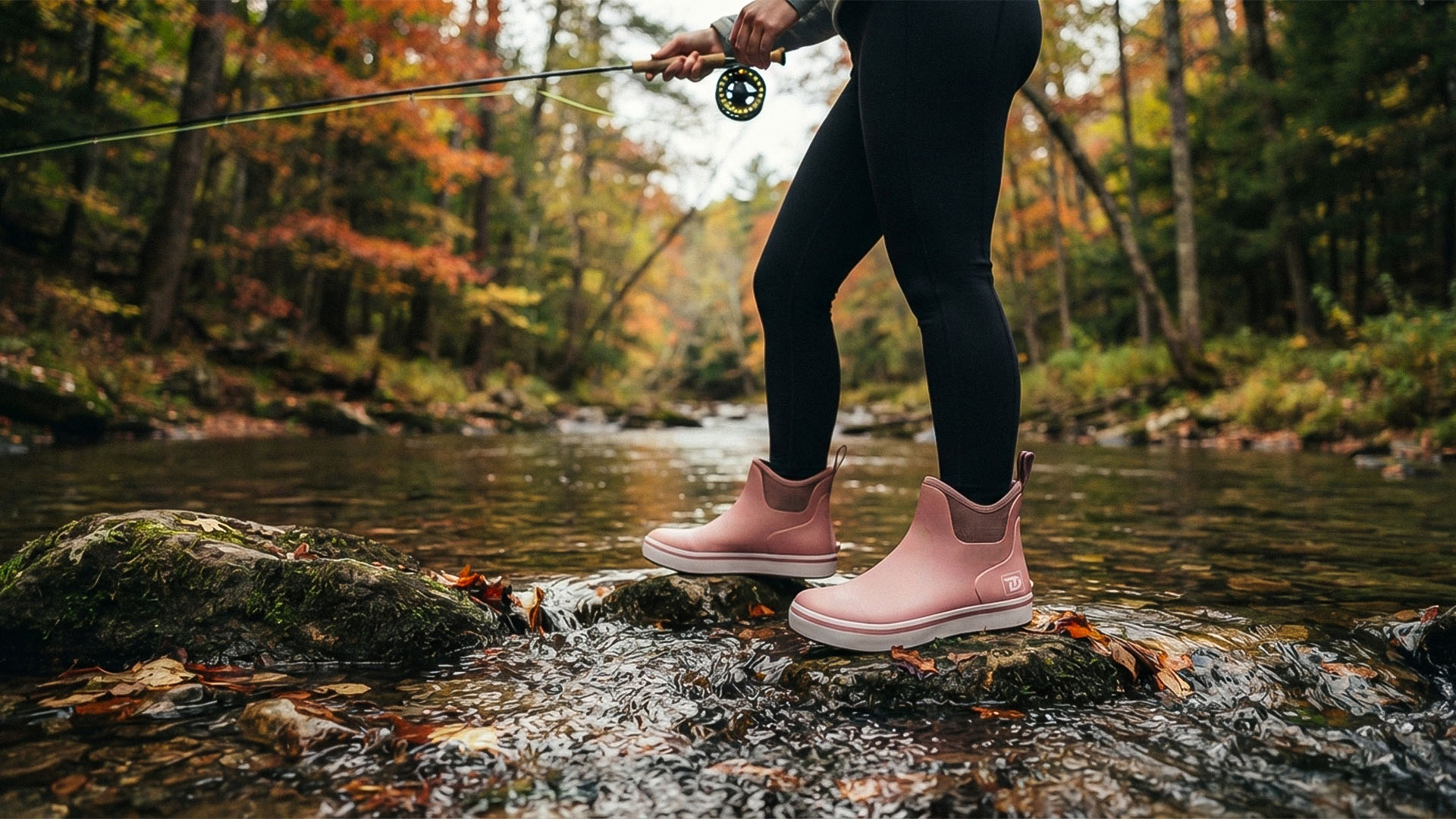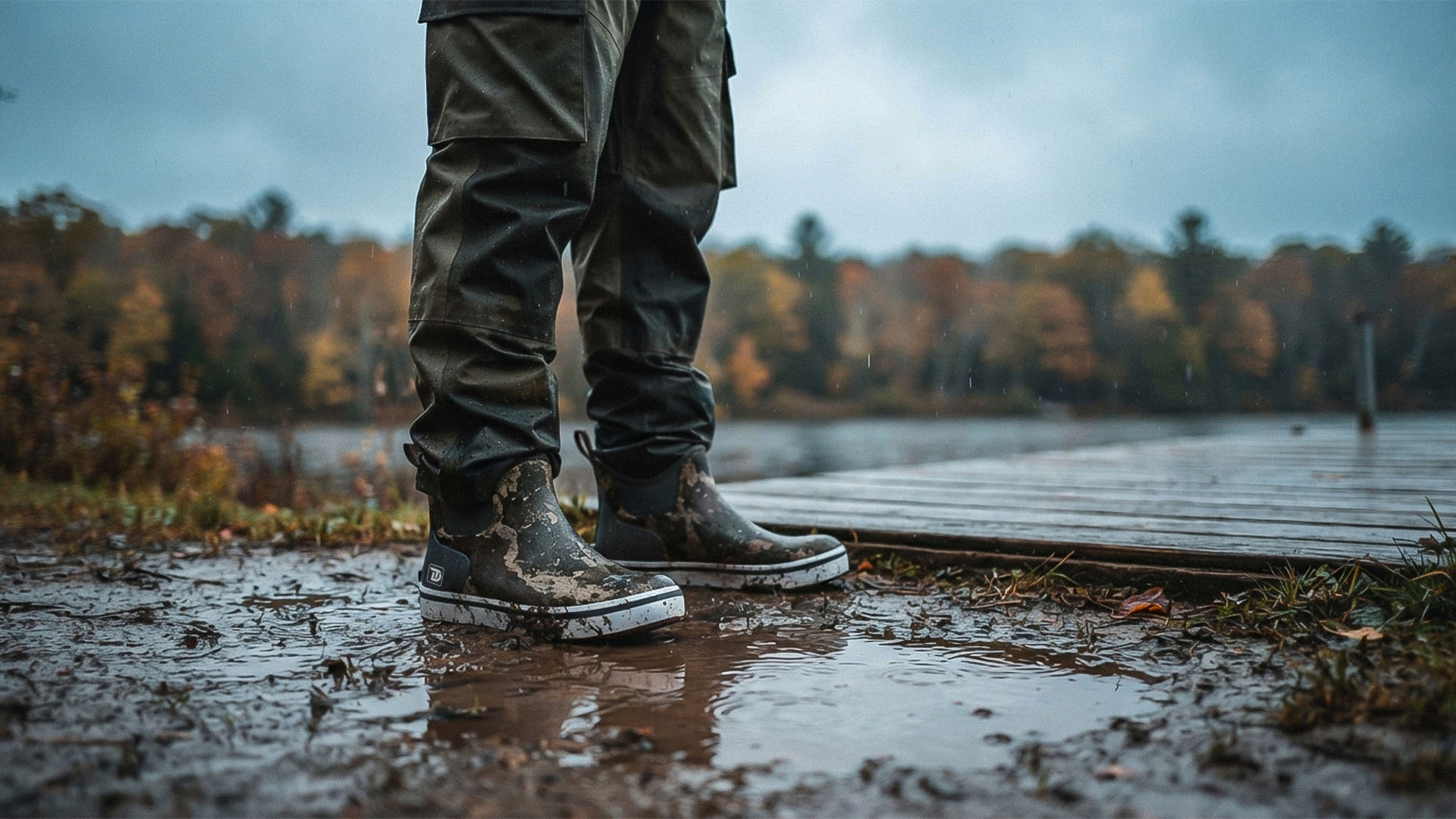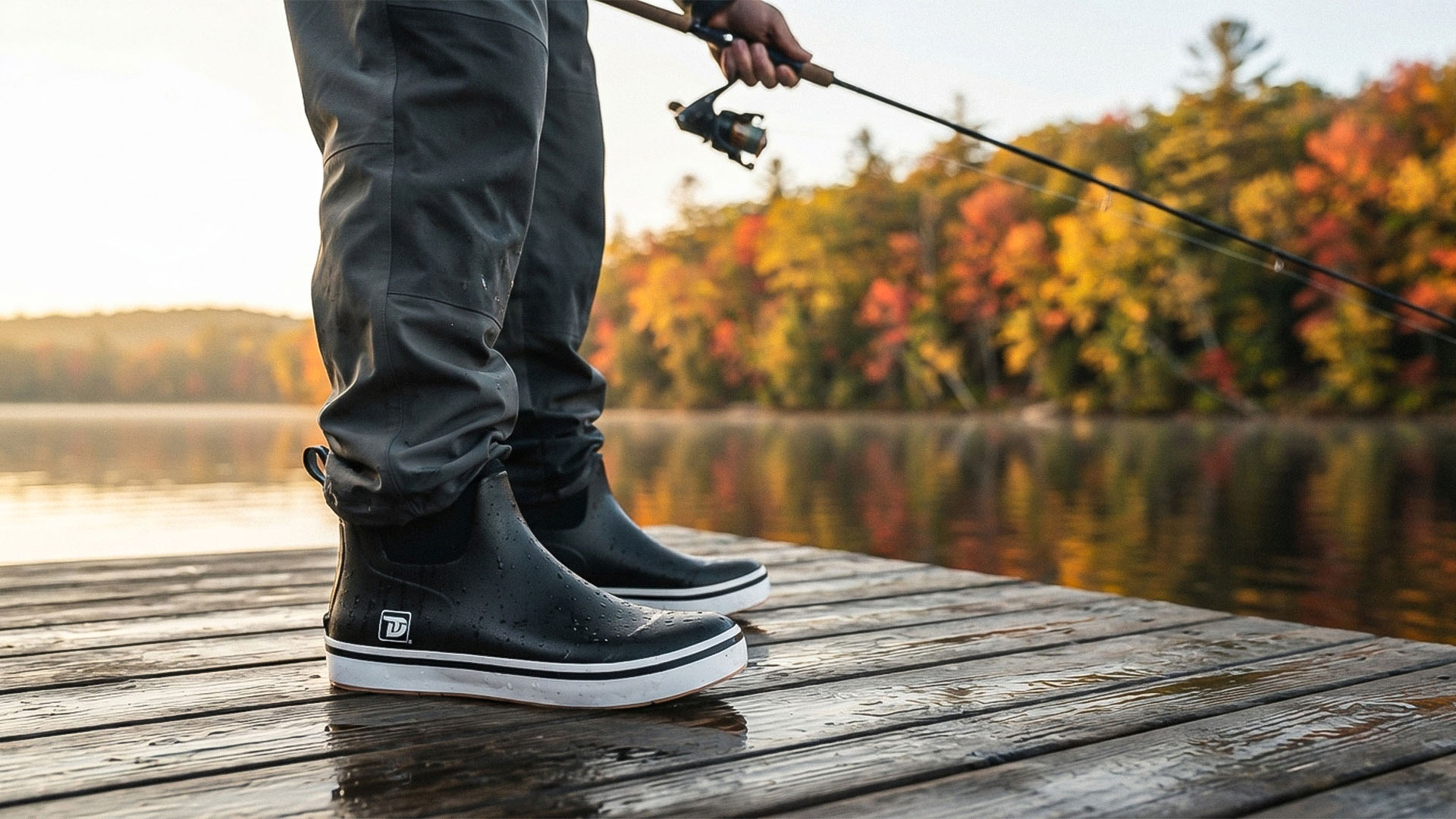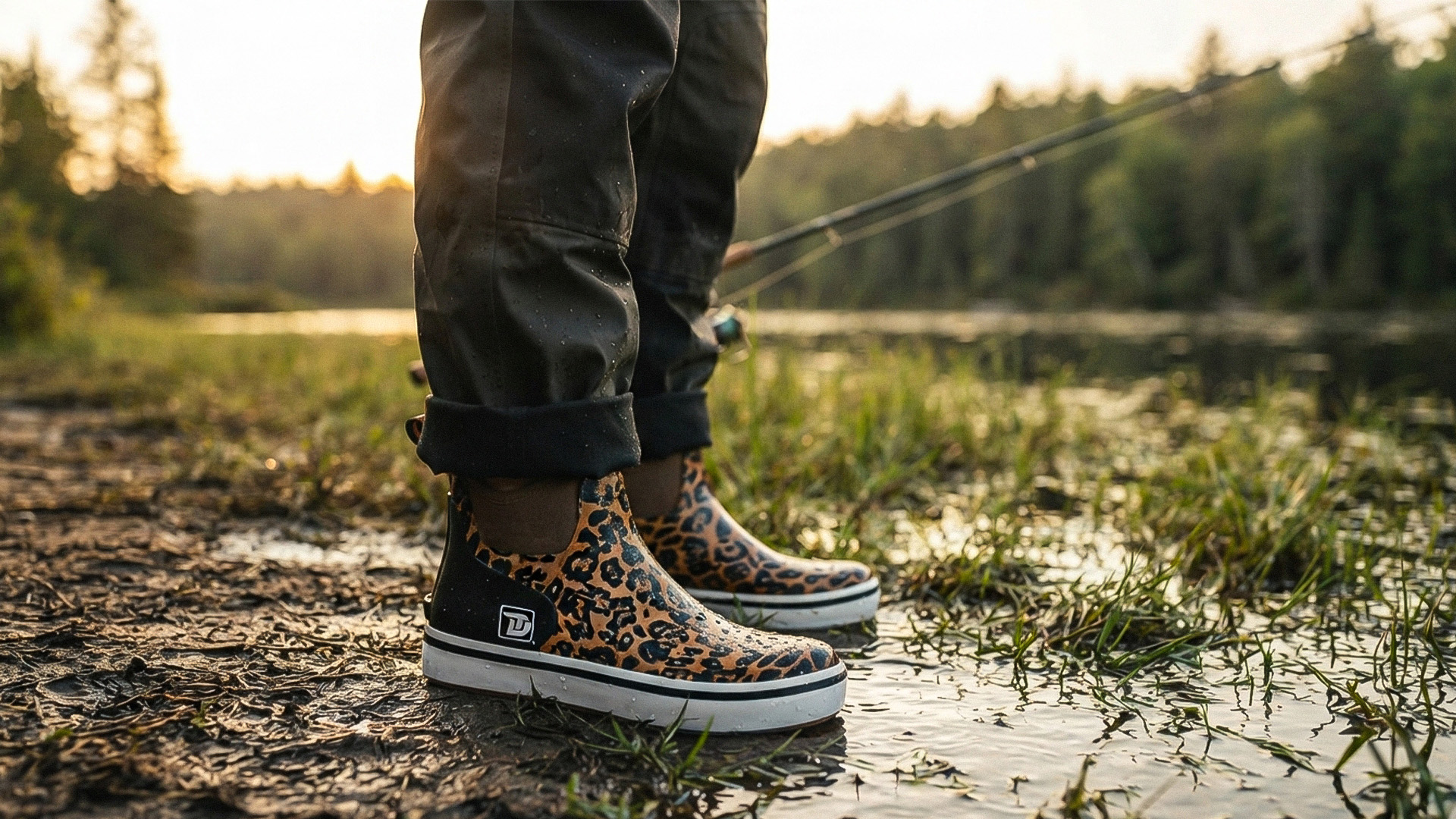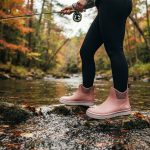
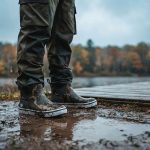
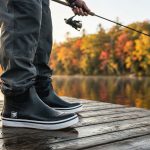
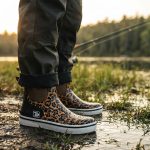
You’ve heard the term “non-slip.” You’ve seen it on boxes, on websites, on the tags dangling from boots in the tackle shop. But here’s the question nobody asks: non-slip compared to what?
Because here’s the uncomfortable truth about deck boots: most of them are only non-slip when they’re brand new. And if you’re like most anglers, you’re not wearing brand-new boots. You’re wearing boots that have been through a season—or three—of saltwater, fish slime, sand, and abrasive fiberglass.
The difference between “non-slip” and “actually grips a wet deck” comes down to one thing you’ve probably never heard of: siping.
And if your boots don’t have it—or if it’s worn away—you’re not walking. You’re hydroplaning.
The Physics of a Wet Deck (And Why Your Sneakers Are a Liability)
Here’s what happens when you step onto a wet fiberglass deck in boots with worn-out tread. Water gets trapped between your sole and the deck. That thin layer of water acts like a lubricant. Your foot doesn’t grip—it floats.
This is the same physics that makes driving dangerous in heavy rain. It’s called hydroplaning. And on a boat deck, it’s just as dangerous as it is on a highway.
The industry standard for measuring slip resistance is ASTM F2913, a test that determines how well footwear grips on wet, oily, and soapy surfaces. Boots that pass this test have been proven to grip when it matters most.
But here’s the catch: that standard is tested on new boots. It doesn’t account for wear. And wear is exactly what makes deck boots fail when you need them most.
What Siping Actually Does (And Why Most Boots Skip It)
Siping is the practice of cutting tiny, razor-thin channels into the surface of a rubber sole. These channels act like miniature squeegees. When you step down on a wet surface, the sipes open up and channel water away from the contact patch. Your rubber meets the deck directly—not a thin layer of water.
Trudave’s WaveLock Series uses micro-channel siping that disperses water instantly, keeping your footing solid even on wet fiberglass or metal surfaces. The DeckFlow Series features non-slip rubber outsoles designed for superior traction on slick boat decks, docks, and marinas.
It’s the same technology used in high-performance racing tires. And it’s the difference between feeling planted and feeling tentative.
But here’s what most brands won’t tell you: siping wears down. Every step on abrasive fiberglass, every grain of sand, every scrape against a dock—it all slowly erodes those tiny channels. And when they’re gone, so is your grip.
The “Bald Tire” Test (That Every Angler Should Know)
Trudave’s gear experts have a simple test for deck boot safety, and it’s the same logic you’d use for tires on your truck. “You wouldn’t drive your truck on the highway with bald tires during a rainstorm. Yet, we see anglers every day hopping onto wet, slimy fiberglass decks with soles that are smooth as glass.”
Here’s how to check your own boots:
- Flip them over. Look at the ball of the foot and the heel. Can you still see distinct lugs—those raised rubber patterns that grip the ground? Or have they worn down into a smooth, featureless surface?
- Check the siping. Those tiny zig-zag cuts in the tread are what channel water away. If they’re worn down and shallow, water has nowhere to go.
- Feel the rubber. Does the sole feel like grippy eraser rubber, or has it hardened into something that feels like hard plastic? Rubber hardens over time, and when it does, traction goes with it.
- Trust your gut. Have you been taking shorter, more cautious steps on a wet deck? Do you feel a micro-slip when you lean into a cast or move from the helm to the stern? If you have to think about your footing, your boots are telling you something.
The bottom line: “Check your tread. If it looks like a racing slick, thank those boots for their service, throw them in the trash, and get some fresh rubber on your feet.”
The Hidden Cost of “Premium” Boots
Here’s what I’ve learned after years of wearing the wrong boots on the wrong decks.
The big brands aren’t magic. They’re using rubber, neoprene, and siping technology—the same materials Trudave uses. The difference is the price tag and the path those materials take to reach your doorstep.
When you pay $150 for a pair of premium deck boots, a significant portion of that price is going to retail markup, distribution costs, marketing campaigns, and decades of brand building—not better materials. When you pay $70 for a pair of Trudave boots, every dollar goes into the boot itself.
Independent reviewers who’ve tested Trudave boots through real-world conditions put it this way: “If you’re hunting, working long shifts outdoors, or just need a reliable pair of waterproof boots that won’t break the bank, Trudave delivers surprisingly solid value—just don’t expect premium-brand polish. What you trade in price, you gain in practicality.”
That “practicality” is the steel shank that provides underfoot puncture protection. The micro-channel siping that keeps you upright. The sealed waterproof construction that keeps your feet dry. The cushioned EVA insoles that keep you comfortable hour after hour.
WaveLock vs. DeckFlow: Which One Fits Your Water?
Trudave offers two deck boot series, each optimized for different conditions and fishing styles.
The WaveLock Series: Cold-Weather Grip. The WaveLock is built for anglers who fish when the water is cold and the air is colder. Early spring stripers. Late-fall trophy hunts. Steelhead trips when you’re scraping frost off the windshield. The thermal insulation traps your body heat when you’re sitting still. The micro-channel siping keeps you planted on wet decks. The non-slip rubber outsole provides excellent traction on slick decks, docks, and other wet surfaces.
The DeckFlow Series: Warm-Weather Traction. The DeckFlow is built for anglers who move. Kayak fishermen, bank anglers, tournament fishermen running the deck all day. The breathable mesh lining pulls sweat away from your skin, preventing the “swamp foot” that plagues fully sealed rubber boots. The non-marking siped outsole channels water away and grips securely on wet wood and fiberglass decks.
| Feature | WaveLock Series | DeckFlow Series |
|---|---|---|
| Primary Use | Cold mornings, early season, stationary fishing | Warm weather, active movement, year-round versatility |
| Lining | Soft thermal insulation + fleece interior | X-Dry moisture-wicking breathable mesh |
| Ideal Temperature | 20°F to 50°F | 45°F to 80°F+ (works in cold with wool socks) |
| Outsole | WaveLock micro-channel siping, non-slip grip | Non-marking siped outsole |
| Key Feature | Stretchy side panels, reinforced heel armor, easy-off heel tab | Lightweight low-cut design, transitions from dock to daily wear |
The year-round hack: If you fish year-round, buy both. Together, they cost less than a single pair of premium boots—and you get the right boot for every condition, not a compromise.
What Real Owners Are Saying
Trudave holds a 4.1 out of 5 rating on Trustpilot based on verified purchaser reviews. Here’s what real owners emphasize about their boots:
“It has been about two months now and these boots are still going strong and keeping our feet protected. Would recommend these boots 100%.”
“Bought some boots from Trudave, These boots are well made and comfortable. The size is slightly larger, but with socks they fit well and comfortably. A size smaller would be too tight.”
Sizing Note: Multiple verified owners report that the boots run slightly large, so wearing medium-to-heavy socks provides optimal fit. One reviewer noted: “Great shoe. Just what I was looking for. The heels rub. That would be my only comment”—a common issue with rubber boots that’s easily addressed by wearing proper sock thickness.
The 7-Day Torture Test: In a brutal field test, Trudave boots were worn continuously for seven days straight—168 hours of field scouting, truck driving, warehouse work, and trudging through flooded timber. The result: no blown seams, no peeling soles, no cracked rubber at the toe flex point. The boots lost their “brand new” shine, but structurally, they were begging for another 100 miles.
Why Deck Boots Matter More Than You Think
When you’re gearing up for a long day on the water, most people think about rods, bait, or navigation tools—but forget the one piece of gear that supports them the most: their boots. Your feet take the brunt of every hour on the boat, and the wrong boots can turn a promising trip into a miserable one.
Hauling nets, fighting fish, or simply moving across the deck while seawater and fish slime splash everywhere—if your boots leak or lack grip, your feet will be cold, heavy, and vulnerable. And one slip could end the day early.
That’s why deck boots are not “just another accessory.” They are essential gear that determines how safe, comfortable, and productive your time on the boat will be.
How to Care for Your Deck Boots
Proper care dramatically extends the lifespan of any boot. Here’s the simple routine that works for both the WaveLock and DeckFlow:
Rinse after every use. Especially after saltwater exposure. A quick fresh-water rinse removes salt crystals, fish residue, and mud that can degrade rubber over time.
Air dry naturally—never use heat. Never put rubber boots on a radiator, in a dryer, or in direct sunlight. Heat cracks rubber and ruins the waterproof seal.
Use mild soap only. For heavy dirt, use mild dish soap and a soft brush. Avoid degreasers, bleach, or harsh chemicals—these strip essential oils from the rubber and cause premature cracking.
Store upright in a cool, dry place away from direct sunlight. Don’t fold or crease the boots, which creates weak points in the rubber.
Check your tread periodically. When the lugs wear down and the sole feels hard like plastic instead of grippy rubber, it’s time for new boots. Don’t wait until you’re slipping on a wet deck to realize your boots are done.
Frequently Asked Questions
Q: How do I know if my deck boots are still safe to wear?
A: Perform the “Bald Tire” test: flip your boots over and check the tread. If the lugs are worn smooth or the rubber feels hard like plastic, it’s time for new boots.
Q: Do Trudave deck boots have slip-resistant soles?
A: Yes. The WaveLock Series features a non-slip rubber outsole with micro-channel siping that disperses water instantly. The DeckFlow Series features non-slip rubber outsoles designed for superior traction on slick boat decks, docks, and marinas.
Q: Are Trudave deck boots 100% waterproof?
A: Yes. Both series are made from premium natural rubber with sealed construction to keep your feet dry while fishing, boating, or working in wet conditions.
Q: Which Trudave deck boot is right for me?
A: Choose WaveLock for cold-weather, stationary fishing (20°F to 50°F). Choose DeckFlow for warm-weather, active fishing (45°F to 80°F+). If you fish year-round, buy both—together they cost less than one pair of premium boots.
Q: How do I clean and maintain my Trudave deck boots?
A: Rinse with fresh water after each use, especially after saltwater exposure. Wipe off dirt with mild soap and air dry naturally. Avoid direct sunlight or heat, which can crack rubber and ruin the waterproof seal.
The Bottom Line
Here’s the honest truth about deck boots in 2026.
Your boots are the foundation of every trip. They’re the only thing between you and a wet deck. And when the tread goes, so does your safety.
Independent reviewers who’ve tested Trudave boots through real-world conditions put it this way: “If you’re hunting, working long shifts outdoors, or just need a reliable pair of waterproof boots that won’t break the bank, Trudave delivers surprisingly solid value—just don’t expect premium-brand polish. What you trade in price, you gain in practicality.”
The WaveLock keeps you warm and planted when you’re sitting still in cold weather. The DeckFlow keeps you comfortable and secure when you’re moving on the deck in warm weather. Both keep you upright—and that’s the only thing that really matters.
| Decision Factor | WaveLock | DeckFlow |
|---|---|---|
| Cold-weather fishing (20°F–50°F) | ⭐⭐⭐⭐⭐ Best in class | ⭐⭐⭐ Requires wool socks |
| Warm-weather fishing (50°F–80°F+) | ⭐⭐ Too hot | ⭐⭐⭐⭐⭐ Best in class |
| Slip resistance | ⭐⭐⭐⭐⭐ Micro-channel siping | ⭐⭐⭐⭐ Non-marking siped outsole |
| Waterproofing | ⭐⭐⭐⭐⭐ | ⭐⭐⭐⭐⭐ |
| Value for money | ⭐⭐⭐⭐⭐ | ⭐⭐⭐⭐⭐ |
The fish don’t care what logo is on your boots. The deck doesn’t check the brand tag. It only cares if you’re still upright—dry, comfortable, and focused—when the bite finally turns on.
Now go check your tread. And if it looks like a racing slick, it’s time for an upgrade.