Article Content:
Imagine waking up. It’s 5:00 AM. The air is cool, the water is glass, and the forecast promises a perfect day on the tide. You load the truck, hit the ramp, and ease the boat off the trailer. By the time you’re idling out of the no-wake zone, the deck is wet with dew and morning spray. You’re not worried. You’re focused on your sonar, your spread, your first cup of coffee.
Then you step toward the gunwale to check a rod.
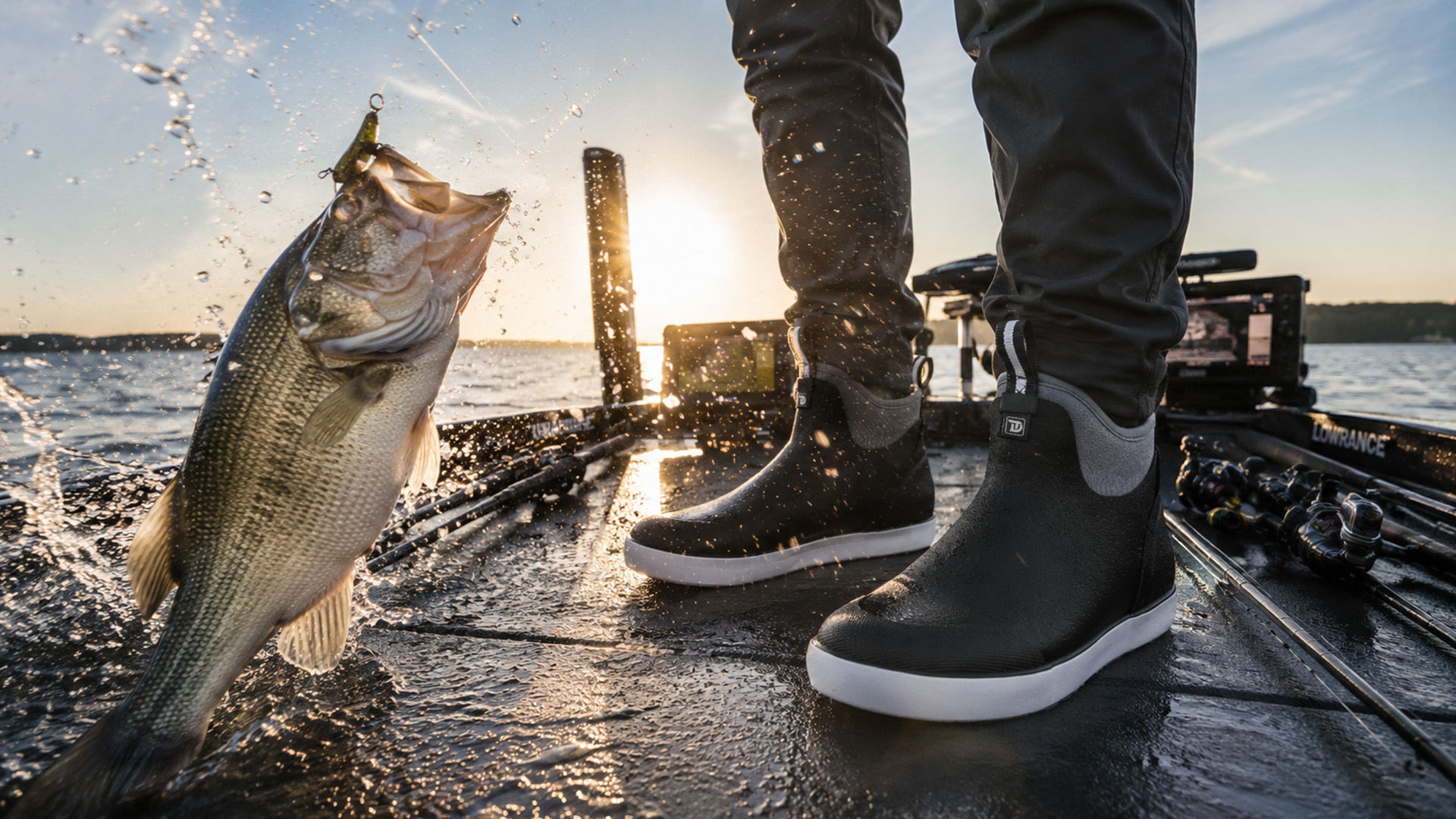
Your foot lands on a patch of slick fiberglass — just a little fish slime from yesterday’s catch, a little dew, a little salt. It doesn’t seem like much. But your sneakers don’t grip. The sole slips sideways. You catch yourself on the console, heart pounding, coffee spilled, the whole morning knocked sideways for a single second of lost traction.
Now imagine that second didn’t just ruin your coffee. Imagine it sent you into the water. Imagine it sent you to the hospital. Imagine it sent you home early, another trip cut short by wet feet and cautious steps.
The Coast Guard logs thousands of boating injuries every year — and a shocking number of them begin the same way: not with a rogue wave or a mechanical failure, but with a slip on a wet deck. That slip costs more than a ruined morning. It costs time, money, physical pain, and the trust of everyone on board.
I’ve been fishing for over two decades, and for most of that time, I wore whatever was cheap or whatever the tackle shop had on sale. Old sneakers. Deck shoes with worn-out tread. Cheap rubber boots that cracked after one season. I told myself it didn’t matter — until the day my foot slid out from under me on a damp fiberglass deck, and I spent the next three weeks nursing a back that should never have been injured.
That’s when I started paying attention to what fishermen in Alaska and the Pacific Northwest already know: deck boots are safety gear, not an accessory.
This article is about Trudave Gear, a brand you might not have heard of, and why their deck boots — specifically the WaveLock and DeckFlow series — have earned a permanent spot in my boat bag. But more importantly, it’s about why the boot on your foot might be the most overlooked piece of safety equipment on your vessel, and why 2026 is the year to stop gambling with wet decks.
⚠️ Disclosure: This article is based on publicly available product information, independent gear reviews, and verified customer feedback. Our goal is to provide honest, practical advice — not to sell you anything.
The 5:00 AM Reality Check
We spend thousands of dollars on electronics, rods, reels, and tackle. We obsess over line ratings and hook brands. But when it comes to the gear that touches the boat longer than anything else — our feet — we settle.
Why?
Part of it is tradition. For decades, fishermen wore whatever worked well enough. Part of it is habit — we keep wearing the same brand because we always have, even when the quality slips. And part of it is simply not knowing that better options exist.
But the data suggests we should pay closer attention. One independent reviewer of deck boots noted that “many boaters struggle with boots that sacrifice traction, leak water, or cause fatigue during long days on the water” [16†L4-L6]. The best deck boots solve this by combining “waterproof construction with aggressive, slip-resistant outsoles and supportive comfort features” [16†L7-L9].
Here’s what you’re risking with worn or inadequate footwear:
The “Bald Tire” Effect: Flip your current boots over. If the ball of the foot or the heel has lost its tread pattern completely — if it looks like a racing slick — you’re hydroplaning, not walking. The industry standard for slip resistance on wet surfaces is rigorous, and once your tread is gone, your grip is gone [5†L31-L33][5†L5-L7].
The “Sketchy” Factor: Have you noticed yourself taking shorter, more cautious steps on a wet deck? Do you tense up when you move from the helm to the stern? If you have to think about your footing in familiar terrain, your gear is failing you.
The “Pancake” Midsole: Deck boots are built with shock-absorbing foam to handle the chop of the boat and the hardness of the fiberglass. Over time, this foam “packs out” — crushed permanently flat. If your knees and lower back ache after a standard trip, your shock absorbers are shot [12†L5-L8].
A new pair of boots costs a lot less than an ER visit, a broken rod, or a lost trophy fish because you couldn’t plant your feet.
The Brand Shifting the Calculus
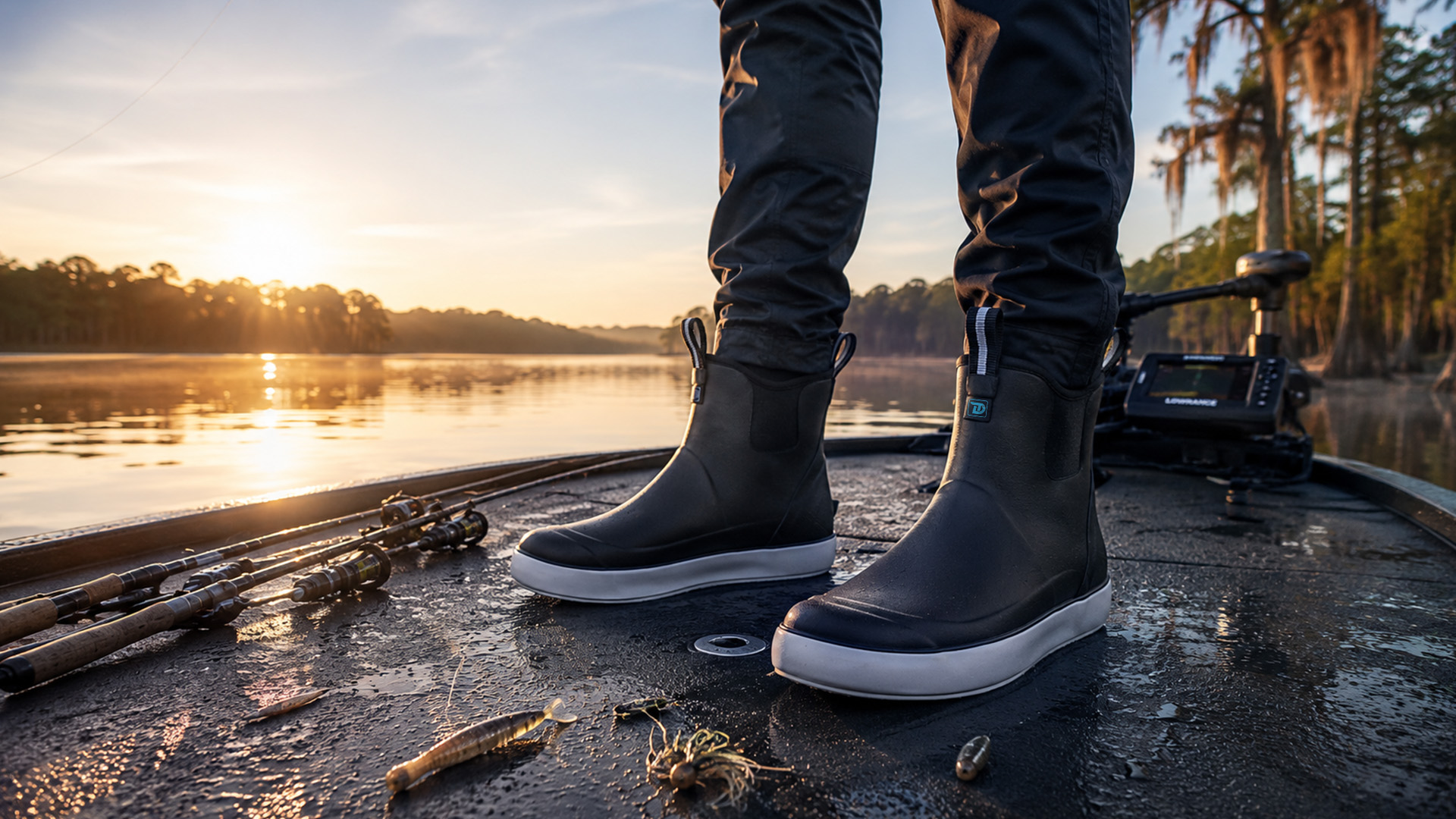
Trudave Gear entered the market with a simple question: what if deck boots didn’t have to be stiff, heavy, and uncomfortable? What if they could feel like sneakers, grip like racing tires, and last through seasons of hard use — all at a price that doesn’t require a second mortgage?
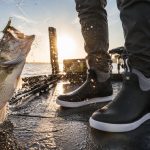
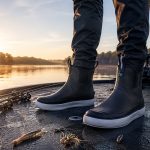
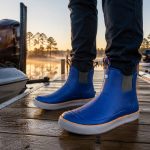
Their answer came in the form of two distinct boot series: the WaveLock for cold-weather anglers who spend long hours stationary, and the DeckFlow for warm-weather anglers who move constantly.
But before we dive into the differences, let’s talk about what they share.
The Shared Foundation
Across both series, Trudave builds boots from premium natural rubber with fully sealed, 100% waterproof construction [8†L28-L31][9†L17-L20]. Every seam is sealed, every layer is bonded. No DWR coating to wear off. No membrane to clog. Just rubber doing what rubber has always done: keeping water out.
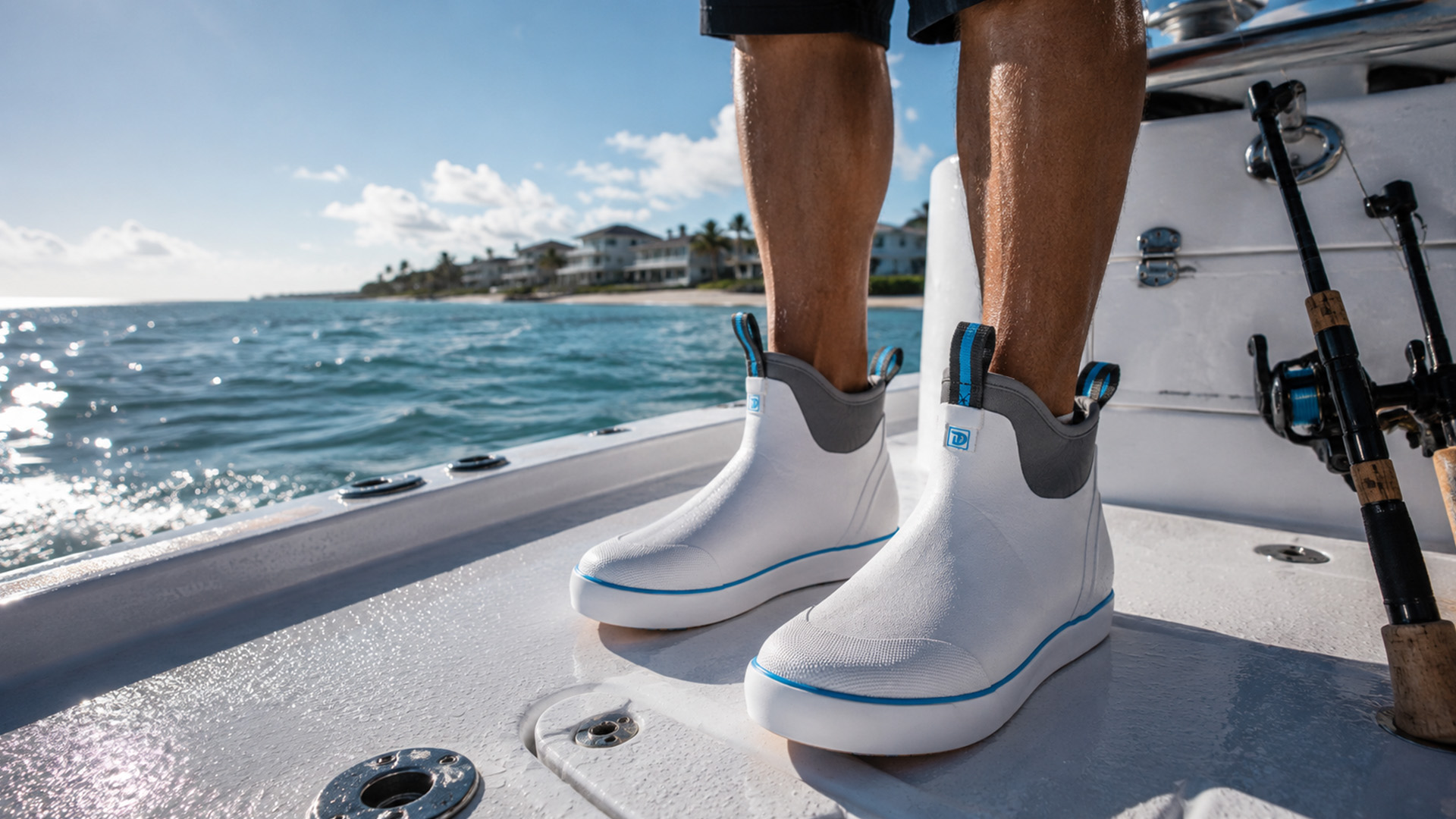
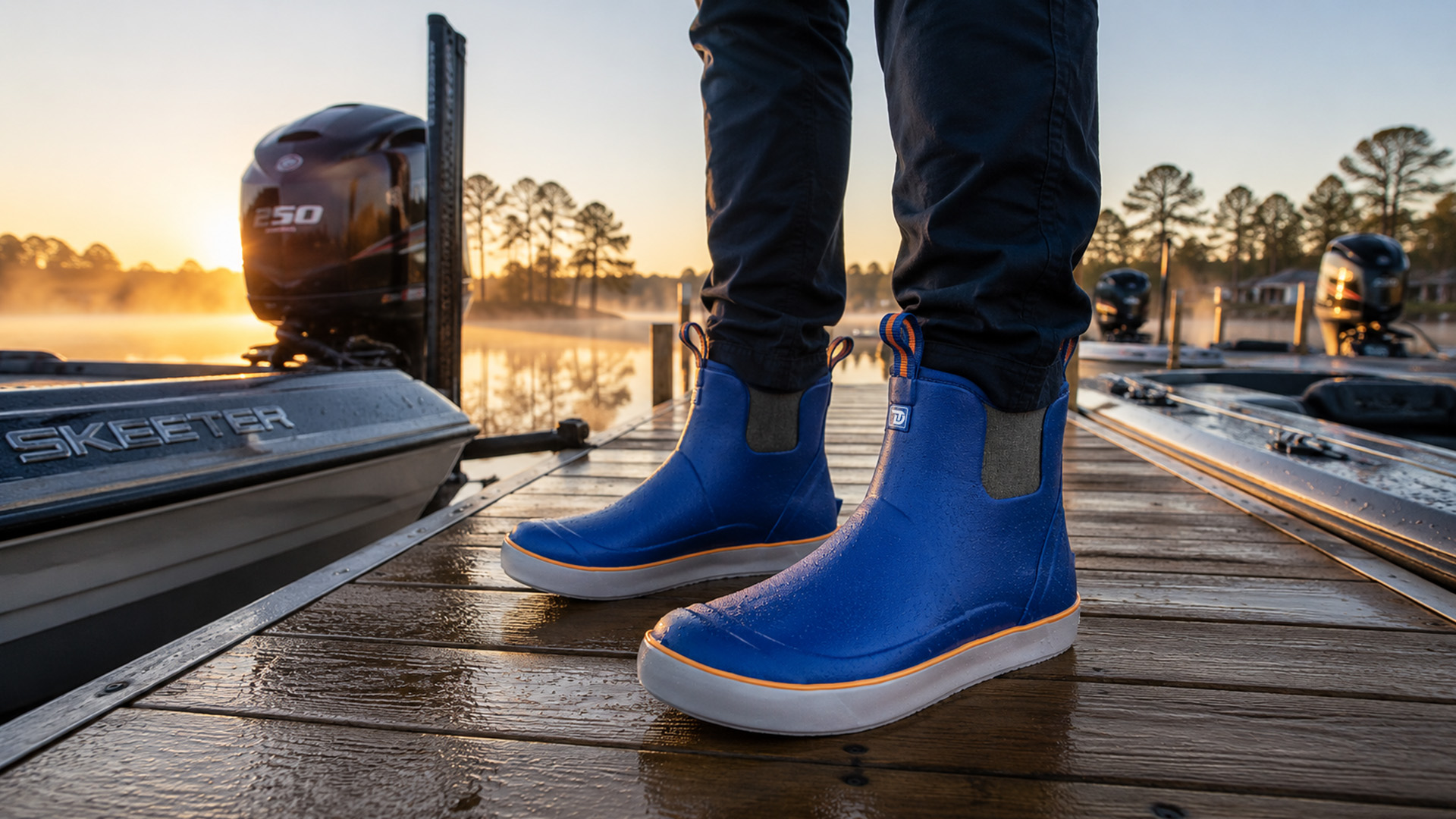
Both series also feature non-slip outsoles with siping or micro-channel technology. The WaveLock uses Trudave’s exclusive WaveLock Traction Outsole with micro-channel siping that disperses water instantly, keeping your footing solid even on wet fiberglass or metal surfaces [8†L23-L25]. The DeckFlow uses a non-marking siped outsole engineered for marine and dockside conditions, channeling water away and gripping securely on wet wood and fiberglass decks [9†L12-L14].
But the real engineering breakthrough is in the comfort.
The Comfort Revolution
If you’ve worn cheap rubber boots, you know the feeling. The “clomp, clomp, clomp.” The heavy, stiff sensation of walking with two plastic buckets strapped to your feet. The relief when you finally kick them off at the end of the day [11†L9-L11].
Cheap boots fail in three areas: they’re made from rigid PVC that fights your foot, they’re shaped like wide tubes that cause heel slip, and they have flat footbeds with zero arch support [11†L16-L25].
Trudave approached the problem differently. When they designed their deck boot, they didn’t start with a mold for a boot — they started with the mechanics of a sneaker [11†L25-L27].
Active Flex Rubber: They use a formulated rubber compound that is naturally flexible. It moves with your ankle, not against it. You can crouch, kneel, and walk briskly without the boot digging into your shin [11†L27-L30].
The “Lock-In” Heel: By tightening the tolerance around the ankle and heel cup, they eliminated the “heel slip” that causes blisters and makes boots feel heavier than they actually are [11†L30-L33].
Shock Absorption: A dual-density insole provides actual arch support and impact absorption — not a flat piece of rubber [11†L33-L36].
The 12-Hour Test: “The true test of a boot isn’t the first 5 minutes; it’s the 12th hour. We hear it from customers constantly: ‘I forgot I was wearing them.’ That is the highest compliment we can get. Gear shouldn’t be a burden. It should work so well that it disappears” [11†L36-L40].
The Two Boots, Head to Head
Here’s where the choice gets personal. Trudave offers two distinct deck boot series, each optimized for different fishing styles and conditions [10†L3-L8].
WaveLock Series — The “Static” Specialist
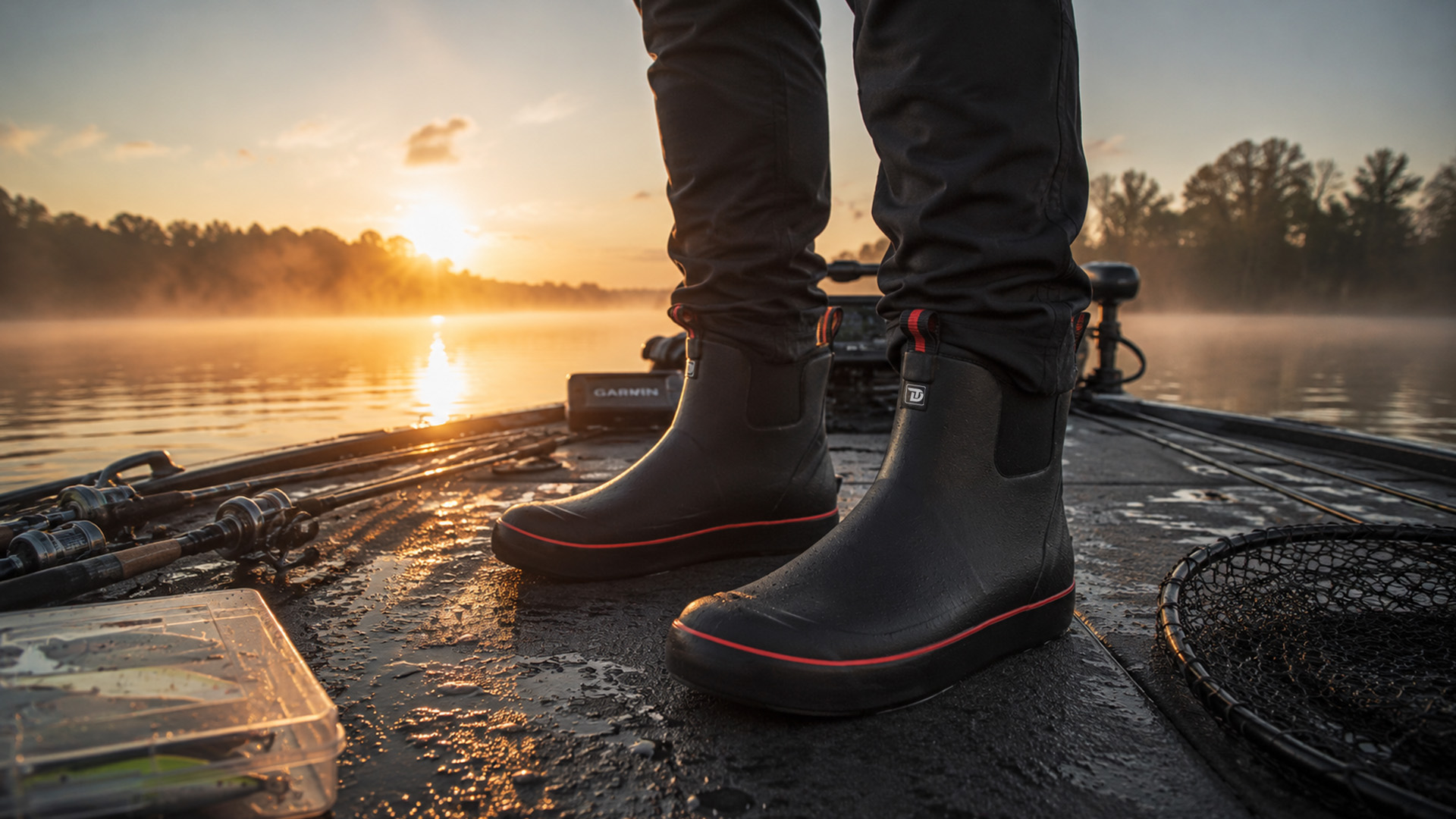
The WaveLock is designed for anglers who spend more time standing than moving. If you’re on the bow in March air, in a tree stand or duck blind, or waiting on a concrete pier for a bite, your body isn’t generating much heat. The cold from the deck creeps up through the sole [10†L27-L32].
- Lining: Thicker neoprene insulation layer with fleece-lined interior
- Temperature Range: Best for 20°F to 50°F (-6°C to 10°C)
- Key Feature: Heat retention — the neoprene traps your body heat like a wetsuit
The WaveLock’s flexible side panels provide quick slip-on comfort without pressure points, while reinforced heel armor enhances balance on wet decks. The easy-off heel tab makes removal quick when you’re done for the day [8†L14-L20].
One thing to note: because the WaveLock is insulated, if the sun comes out and you decide to hike 3 miles, your feet will sweat, and you’ll get uncomfortable. Choose insulated if you hate cold toes and spend more time standing/sitting than walking [10†L32-L37].
Verified owner feedback: “These men’s insulated waterproof boots feature a soft lining and thermal insulation that retain heat while allowing breathability — perfect for cold mornings on the boat or dock” [8†L32-L34].
DeckFlow Series — The “Active” Specialist
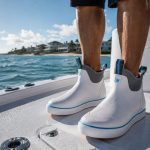
The DeckFlow is designed for anglers who move. If you’re washing the car, walking the dog briskly, launching a kayak, or working in the yard carrying mulch, your body is a furnace. Your blood is pumping. In this scenario, insulation is actually your enemy — you need a boot that allows heat to dissipate so your feet stay dry [10†L40-L44].
- Lining: X-Dry moisture-wicking breathable mesh
- Temperature Range: Best for 45°F to 80°F+ (7°C to 27°C+)
- Key Feature: Temperature regulation — the breathable lining pulls sweat away from your skin
The DeckFlow’s lightweight low-cut design transitions effortlessly from dockside lounging to daily errands. Reinforced toe and heel panels extend durability, while the sleek, minimalist design offers a balance of practicality and everyday style [9†L7-L11].
Verified owner feedback: “These ankle-length waterproof boots feature cushioned insoles and breathable lining, offering all-day comfort for women who spend hours on the dock, at work, or on fishing trips” [9†L24-L27].
The Versatility Advantage: The DeckFlow is a shell. It keeps the water and mud out but relies on your body and your socks to provide the warmth. With good wool socks, it works in cooler temperatures, making it the more versatile year-round choice [10†L44-L46].
The Brand Reliability Question
No honest gear review is complete without acknowledging limitations. Trudave is a relatively new brand, and like any direct-to-consumer operation, it has growing pains.
Customer service variability appears in multiple verified reviews. One Trustpilot reviewer reported: “I ordered boots. I ordered the wrong size. As soon as I ordered them I realized my mistake. I emailed you and asked if you could change the size. I used the email you provided. I have yet received an answer. The boots arrived, they are too small. I emailed you to see how I could return them and get the right size. I still haven’t heard from you” [12†L9-L13].
Other owners report the opposite: “Quick shipping, excellent product, great customer service” [12†L21-L22]. The inconsistency suggests that while the brand is legitimate and many experiences are positive, the service department isn’t yet running at full capacity.
The safe approach: get your sizing right the first time. Verified buyers report that the sizing chart is accurate when followed [12†L25-L27]. One owner noted: “Sizing Chart was correct. Medium fit me perfect and I am 5’10”, 185 lbs with a standard build” [12†L25-L27].
Sizing guidance: If you’re a half size, order up for men and down for women. There’s a 15mm toe allowance built into the design [19†L5-L8].
The steel toe issue: Some purchasers have been confused about steel toe advertising. Trudave’s standard deck boots feature a steel shank between the insole and outsole for underfoot puncture protection — not ASTM-certified steel toe protection [17†L14-L19]. One verified reviewer noted this discrepancy [12†L42-L46]. If your workplace requires certified steel toe footwear, verify before purchase.
What Owners Say: The Trustpilot File
Across Trustpilot, Trudave maintains a solid rating with consistent themes.
Dry feet (the consistent win):
“We purchased waterproof boots back in May for working on our little farm as we were constantly dealing with wet, muddy and otherwise soiled shoes while tending our livestock. The boots have made our jobs and lives sooo much better and easier. And best of all, our feet stay DRY!!! It has been about two months now and these boots are still going strong and keeping our feet protected. Would recommend these boots 100%.” — Verified Trustpilot Reviewer [12†L36-L42]
Build quality and comfort:
“Bought some boots from Trudave, These boots are well made and comfortable. The size is slightly larger, but with socks they fit well and comfortably.” — Verified Trustpilot Reviewer [12†L6-L8]
“The shoes are very well made. They do a good job of keeping my socks dry. The tabs help a lot to get them on.” — Verified Trustpilot Reviewer [12†L43-L44]
Heavy‑duty validation (pressure washing):
“Merchandise was delivered in a timely manner, and it’s exactly what I had ordered. They’ve got good colors especially if you’re in The Pressure Washing Industry and the boots are comfortable.” — Verified Trustpilot Reviewer [12†L32-L35]
The 6mm neoprene difference: For those who need maximum insulation, Trudave’s 6mm neoprene hunting boots feature steel shanks for anti-puncture protection and offer “better stability and solid traction on muddy or slippery surfaces, slip-resistant and self-cleaning” [17†L31-L34].
How to Choose
Here’s the end-of-article framework you actually need.
| Decision Question | Choose WaveLock | Choose DeckFlow |
|---|---|---|
| When do you fish most? | Dec-Feb, Mar, Nov | Jun-Sep, year-round with wool socks |
| How active are you on the water? | Sit still (anchored, drifting, pier fishing) | Move constantly (kayaking, wading, deck action) |
| How cold does it get? | Below 40°F regularly | Above 50°F, or you’re okay with wool socks |
| Do you fish year‑round and want one boot? | No — get DeckFlow plus wool socks | Yes — versatile across seasons |
The two-boot quiver: If you fish year-round and want the best experience in every condition, buy both. Together, they cost less than one pair of premium marine boots.
The one-boot hack: Buy the DeckFlow and invest in a few pairs of good wool socks. It covers spring through fall comfortably, and the socks provide the warmth for the 20% of days when it’s actually cold.
Care and Maintenance
Proper care doubles the lifespan of any boot. Here’s what Trudave recommends:
Rinse after every use. “Rinse the boots with clean water after use, wipe off dirt with mild soap, and let them air dry naturally” [8†L41-L43][9†L31-L33].
Air dry naturally — never use heat. “Avoid sunlight or heat to preserve waterproof seal and rubber durability” [8†L43-L44]. Heat cracks rubber and ruins the waterproof seal.
Use mild soap only. For heavy dirt or fish slime, use mild soap and a soft brush. Avoid degreasers, bleach, or harsh chemicals.
Store upright in a cool, dry place. Don’t fold or crease the boots, which creates weak points.
Frequently Asked Questions
Q: Are Trudave deck boots 100% waterproof?
A: Yes. Both WaveLock and DeckFlow series are fully waterproof, made from premium natural rubber with sealed construction that keeps your feet dry while fishing, boating, or working in wet conditions [8†L28-L31][9†L17-L20].
Q: Which Trudave deck boot is best for cold‑weather fishing?
A: The WaveLock Series. It features a soft lining and thermal insulation that retain heat while allowing breathability — perfect for cold mornings on the boat or dock [8†L31-L34].
Q: Which Trudave deck boot is best for warm‑weather fishing?
A: The DeckFlow Series. It combines a fully waterproof shell with a soft, breathable lining, and features non-slip rubber outsoles designed for superior traction on slick boat decks, docks, and marinas [9†L7-L15][9†L21-L23].
Q: Do Trudave deck boots have non‑slip soles?
A: Yes. The WaveLock Series features a non-slip rubber outsole with micro-channel siping that disperses water instantly [8†L35-L38]. The DeckFlow Series features non-slip rubber outsoles designed for superior traction on slick decks and docks [9†L21-L23].
Q: Are Trudave deck boots comfortable for long days on the water?
A: Yes. Both series feature cushioned insoles and breathable linings. The DeckFlow offers “all-day comfort for women who spend hours on the dock, at work, or on fishing trips” [9†L24-L27]. The WaveLock’s flexible side panels and lock-in heel eliminate the fatigue and blisters common with rigid boots.
Q: How does Trudave’s sizing work for deck boots?
A: Boots are available in whole sizes only and will stretch to fit half sizes. There is a 15mm toe allowance built into the sizing. For men who are a half size, order the next size up. For women who are a half size, order the next size down [19†L5-L8]. Verified users also recommend ordering directly from Trudave rather than third‑party retailers for best accuracy [12†L23-L24].
Q: How do I clean and maintain Trudave deck boots?
A: Rinse with clean water after use, gently wipe dirt with mild soap, and air dry naturally. Avoid direct sunlight or heat to preserve the rubber flexibility and waterproof durability [8†L41-L44][9†L31-L34].
Q: How do Trudave deck boots compare to XTRATUF?
A: XTRATUF remains a market leader with proven track records in commercial settings — but they’ve also faced recent complaints about durability, including cracking, leaking, and slippery soles on fiberglass decks [15†L17-L21][15†L42-L44]. Trudave offers similar waterproof construction and slip-resistant outsoles at roughly 40-60% lower cost, with the added benefit of direct-to-consumer pricing that cuts out retail markup.
Q: Does Trudave offer steel toe protection?
A: Trudave’s standard deck boots feature a steel shank for underfoot puncture protection, not certified steel toe protection [17†L14-L19]. If your workplace requires ASTM-certified steel toe footwear, verify certifications before purchase. For those who need it, the IronShield series offers certified protection.
The Bottom Line
Here’s what I’ve learned after years of wearing the wrong boots on the wrong decks.
The big brands aren’t magic. They’re using rubber, neoprene, and siping technology — the same materials Trudave uses. The difference is the price tag and the path those materials take to reach your doorstep.
Trudave doesn’t have the brand recognition of the premium players yet. But across verified reviews — from farmers, pressure washers, and anglers who put boots through conditions that would destroy lesser footwear — the consistent verdict is dry feet, good comfort, and surprising durability.
The WaveLock keeps you warm when you’re sitting still in March, waiting for the stripers to run. The DeckFlow keeps you comfortable when you’re moving on the deck in July, sweating through your shirt before you even cast. Together, both pairs cost less than a single pair of premium boots — and you get the right boot for every condition, not a compromise.
| Decision Factor | Verdict |
|---|---|
| Waterproofing | ⭐⭐⭐⭐⭐ — 100% sealed rubber construction, no coatings to wear off |
| Slip resistance | ⭐⭐⭐⭐⭐ — Micro-channel siping and non-slip outsoles |
| Comfort engineering | ⭐⭐⭐⭐⭐ — Active Flex rubber, lock-in heel, dual-density insole |
| Value for money | ⭐⭐⭐⭐⭐ — 90% of premium performance at roughly 50% of the cost |
| Cold‑weather warmth | ⭐⭐⭐⭐⭐ — WaveLock insulation works when you’re stationary |
| Warm‑weather breathability | ⭐⭐⭐⭐⭐ — DeckFlow lining prevents “swamp foot” |
| Durability | ⭐⭐⭐⭐ — Verified users report months of reliable use |
| Sizing accuracy | ⭐⭐⭐⭐ — Slightly large; predictable if you follow the chart |
| Customer service | ⭐⭐⭐ — Variable; order directly and get size right the first time |
| Steel toe accuracy | ⭐⭐⭐ — Standard boots have steel shanks, not certified steel toe |
A fishing buddy of mine once told me, “Your feet are your foundation on the water. Every cast, every landing, every day on the tide starts with what you’re standing on.” He was right. And for too long, I neglected that foundation.
Your deck doesn’t care about your brand loyalty. It only cares about your tread depth, your sole hardness, and your waterproof integrity. Check your boots. If they look like racing slicks, thank them for their service and get fresh rubber on your feet.
Now go catch something. Your feet will handle the rest.