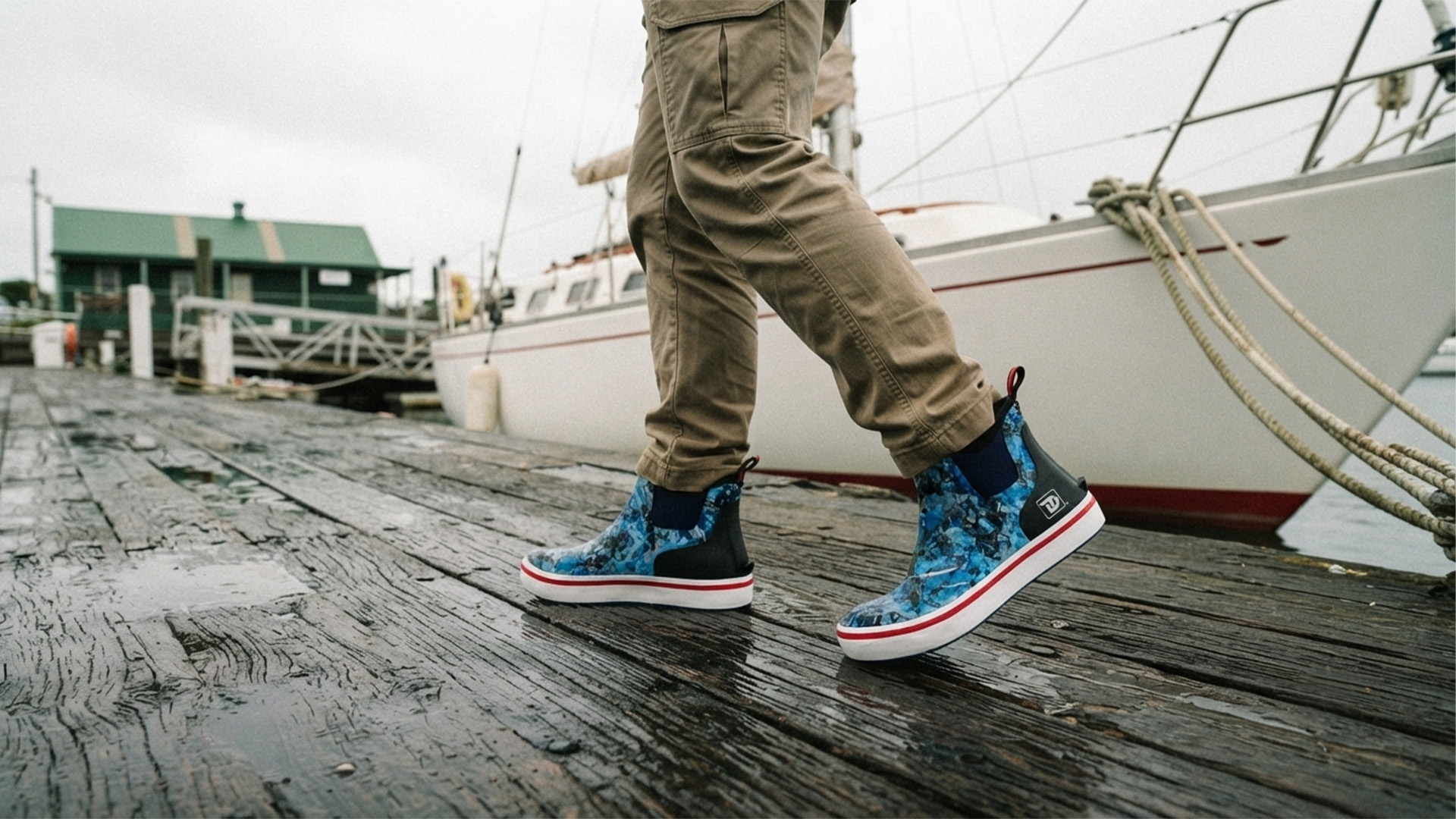
Meta Description: Learn why deck boots feel loose, how much heel slip is normal, and how socks, insoles, sizing, width, and boot shape affect fishing-boot fit.
Suggested URL Slug: why-do-deck-boots-feel-loose
Primary Keyword: why do deck boots feel loose
Secondary Keywords: deck boot heel slip, how should deck boots fit, fishing boots too loose, deck boot sizing guide, fix heel slip in rubber boots, should deck boots fit tight, waterproof fishing boot fit
Search Intent: Informational / Commercial Investigation
Pull-on deck boots will not fit exactly like lace-up hiking boots or athletic shoes.
Because they do not use laces, straps, or buckles, they cannot be tightened around the ankle and midfoot. A small amount of heel movement may occur as you walk, especially in low-cut waterproof models.
However, there is an important difference between normal pull-on movement and a boot that is genuinely too loose.
Deck boots should move with your feet when you turn, step sideways, climb aboard, or balance on a moving boat. They should not feel as though they are falling off, rotating around the foot, or forcing your toes to grip the insole to keep them in place.
Excessive heel slip can cause blisters, fatigue, sock movement, reduced stability, and poor control on wet surfaces.
The solution is not always buying a smaller size.
Loose deck boots may result from incorrect length, excessive width, a narrow heel, low instep volume, compressed insoles, thin socks, or a boot shape that simply does not match your foot.
This guide explains how deck boots should fit, how much heel movement is normal, why some pairs feel loose, and how to improve fit without creating pressure or restricting circulation.
How Should Deck Boots Fit?
A properly fitted deck boot should feel secure without squeezing the foot.
The boot should provide:
- Enough toe room
- Minimal side-to-side movement
- Secure midfoot contact
- Limited heel lift
- Stable turning
- Comfortable instep pressure
- Space for appropriate socks
- No painful rubbing
Your toes should not touch the front while standing or walking downhill.
The sides of the forefoot should not feel compressed.
The heel may move slightly, but it should remain controlled.
When you take a step, the boot should follow your foot almost immediately rather than lifting noticeably after the foot has already moved.
Is Heel Slip Normal in Deck Boots?
A small amount of heel slip can be normal in pull-on footwear.
Deck boots need enough room around the ankle and instep for the foot to enter. Unlike lace-up shoes, they cannot be tightened after you put them on.
Normal heel movement is usually:
- Minor
- Consistent
- Not painful
- Not noticeable during every step
- Not enough to pull socks downward
- Not enough to make the boot feel unstable
Excessive heel slip is more likely when:
- The heel lifts significantly with every step
- The foot rotates inside the boot
- The boot feels delayed during turns
- Socks bunch beneath the heel
- Blisters form
- The boot makes a loud slapping motion
- The boot feels as though it may come off
- You must curl your toes to hold it in place
Minor movement is acceptable.
Loss of control is not.
Why Pull-On Boots Fit Differently From Lace-Up Shoes
Lace-up shoes can be adjusted across several areas:
- Forefoot
- Midfoot
- Instep
- Ankle
- Heel
Pull-on boots depend entirely on their molded shape.
They must balance two opposing requirements.
The opening and instep must be large enough for your foot to enter, but the heel and midfoot still need to hold the foot securely after the boot is on.
That is why two deck boots labeled with the same size can fit very differently.
One may have:
- Narrow heel cup
- Wide toe box
- High instep volume
- Deep footbed
- Tight ankle opening
Another may have:
- Wide heel
- Tapered toe box
- Low instep
- Shallow footbed
- Open collar
The size number is only part of the fit.
Boot shape matters just as much.
The Boot May Be Too Long
The most obvious cause of looseness is excessive length.
A boot may be too long when:
- There is a large gap in front of the toes
- The foot slides forward during downhill walking
- The forefoot bends behind your natural toe joint
- The heel lifts dramatically
- The boot feels difficult to control on stairs
- Your toes grip the footbed during walking
Extra length affects more than comfort.
It can also make the boot flex in the wrong location.
Over time, incorrect flexing may contribute to:
- Toe-area creasing
- Material stress
- Foot fatigue
- Unstable turning
- Premature upper damage
Do not buy a longer size simply because the boot feels tight across the width or instep.
A longer boot may solve one pressure point while creating a larger heel-slip problem.
The Boot May Be Too Wide
Some people have a normal-length foot with a narrow heel or low-volume midfoot.
A standard-width deck boot may feel loose even when the toes are positioned correctly.
Signs of excessive width include:
- Side-to-side foot movement
- Heel rotation
- Forefoot sliding
- Socks twisting
- Difficulty controlling the boot on slopes
- Stable length but unstable volume
A smaller size may be too short.
The better solution may be:
- A narrower model
- A boot with a more defined heel cup
- A higher-volume insole
- Slightly thicker socks
- A different internal shape
Sizing down is not always the correct answer.
Narrow Heels Are a Common Fit Challenge
Many people have a wider forefoot and a narrow heel.
This foot shape can be difficult to fit in pull-on footwear.
A boot that feels comfortable around the toes may feel loose around the heel.
Look for models with:
- Sculpted heel cups
- Internal heel padding
- Secure rear shape
- Removable insoles
- Moderate ankle opening
- Wider toe box with narrower rear fit
A lace-up fishing shoe may provide more precise adjustment for extremely narrow heels.
However, a well-shaped deck boot can still provide secure marine footwear without laces.
Low Instep Volume Can Make Boots Feel Loose
The instep is the top portion of the foot between the toes and ankle.
People with low insteps may have empty space above the foot, even when the length and width are correct.
This can allow the foot to lift inside the boot.
Signs include:
- Vertical movement through the midfoot
- Loose feeling above the arch
- Heel movement without toe pressure
- Boots that feel better with thicker insoles
- Difficulty finding secure pull-on footwear
A supportive insole that slightly raises the foot may improve contact.
However, the insole should not make the collar, instep, or toe box painfully tight.
High Instep Feet Create the Opposite Problem
A person with a high instep may need extra vertical space to enter the boot.
They may choose a larger size because the correct length feels difficult to put on.
This often creates:
- Excessive toe space
- Heel movement
- Poor flex location
- Side-to-side sliding
The real issue may be boot volume rather than length.
Look for:
- More generous instep construction
- Flexible boot opening
- Strong pull tabs
- Higher-volume last
- Wide sizing when appropriate
Do not force a low-volume deck boot onto a high-instep foot.
Excessive pulling can damage the boot and create painful pressure.
Compressed Insoles Can Make Older Boots Feel Larger
Deck boots may fit securely when new and become looser over time.
This does not necessarily mean the upper stretched significantly.
The change may come from:
- Compressed footbed foam
- Flattened heel cushioning
- Worn lining
- Reduced arch structure
- Moisture damage
- Repeated long-term use
When the insole becomes thinner, the foot sits lower and has more interior space.
This can increase heel lift and rotation.
Remove the insole and inspect it for:
- Permanent heel impressions
- Flattened foam
- Cracks
- Torn fabric
- Uneven compression
- Loss of arch shape
Replacing the insole may restore fit when the boot structure, tread, and waterproofing remain healthy.
The Boots May Feel Loose With Thin Socks
Sock thickness changes internal volume.
A boot fitted with medium-weight socks may feel loose when worn with very thin no-show socks.
For warm-weather fishing, choose lightweight socks that still provide:
- Heel coverage
- Friction control
- Moisture management
- Enough thickness for stable fit
Crew-length synthetic or lightweight merino-blend socks usually work well with ankle deck boots.
Avoid using extremely thick socks simply to fill a large boot.
That may create too much warmth and uneven pressure.
Cotton Socks Can Make Heel Slip Worse
Cotton absorbs sweat and water.
As the sock becomes wet, it may:
- Stretch
- Slide
- Bunch
- Lose shape
- Increase friction
- Pull downward around the heel
This can make a slightly loose boot feel much worse.
Synthetic and merino-blend socks generally maintain their shape better in wet marine conditions.
They also manage moisture more effectively.
Can Thicker Socks Fix Loose Deck Boots?
Thicker socks may improve a boot that is only slightly loose.
They are most useful when:
- Length is correct
- Heel movement is minor
- Weather is cool
- The boot has enough toe room
- The sock does not restrict circulation
Thicker socks are not a good solution when:
- The boot is clearly too long
- The foot rotates significantly
- The heel nearly leaves the boot
- Multiple socks are needed
- Toes become compressed
- Feet overheat
- Instep pressure develops
If you need several thick layers to keep the boot on, the size or shape is probably wrong.
Can an Insole Fix Heel Slip?
A replacement insole can help when the boot has slightly too much internal volume.
An insole may:
- Raise the heel
- Improve arch contact
- Fill space beneath the foot
- Reduce side-to-side movement
- Restore compressed cushioning
- Improve all-day comfort
Choose an insole that fits the boot correctly.
It should not:
- Curl at the edges
- Slide
- Shorten toe room
- Make the instep painful
- Raise the heel above the boot’s secure area
- Create an unstable soft platform
Insoles are useful for minor fit adjustment.
They cannot fix a boot that is substantially too large.
Full-Length Insoles vs. Heel Inserts
A full-length insole usually provides a more stable adjustment than a small heel insert.
Full-length insoles support the entire foot and are less likely to create an abrupt height change.
Heel inserts may sometimes:
- Raise the heel too high
- Push the foot forward
- Reduce collar security
- Create pressure
- Move inside the boot
Use heel-only products cautiously.
The boot should remain stable on a moving deck.
Do Not Stack Multiple Insoles Without Testing
Stacking footbeds may reduce interior volume, but it can also create problems.
Multiple insoles may:
- Raise the foot too high
- Compress the toes
- Increase instep pressure
- Reduce ankle stability
- Shift during walking
- Make the boot harder to remove
A properly selected single replacement insole is usually better than several layers of improvised padding.
Test the boot while:
- Standing
- Walking
- Turning
- Squatting
- Climbing steps
- Wearing fishing socks
Heel Grips May Not Work Well in Wet Boots
Adhesive heel grips are commonly used in dress shoes and casual footwear.
They may be less reliable inside waterproof fishing boots because of:
- Sweat
- Moisture
- Curved heel surfaces
- Lining texture
- Repeated boot removal
- Saltwater exposure
A loose heel pad can bunch or create a blister.
Use only products that remain securely attached and are compatible with the lining.
A different boot shape is often the better long-term solution.
Should Deck Boots Fit Tight?
Deck boots should fit securely, not tightly.
A boot that is too tight may cause:
- Toe pressure
- Numbness
- Reduced circulation
- Instep pain
- Difficulty removing the boot
- Cold feet
- Blisters
- Excessive pressure from swelling
Feet may swell slightly during long periods of standing.
Leave enough room for normal movement and appropriate socks.
A close fit around the heel and midfoot is useful, but pain is not.
Toe Room Requirements
Your toes should be able to move without hitting the front.
A practical fit should provide:
- No toenail contact
- No side compression
- No toe curling
- No forward sliding
- Space for slight swelling
Excessive toe room is also a problem.
A very large gap can cause the boot to flex incorrectly and the foot to slide.
The goal is functional space, not empty space.
How to Check Deck Boot Length
Try the boots with the socks you plan to wear.
Stand normally.
Check that:
- The toes do not touch the front
- The heel sits near the rear
- The forefoot bends where the boot bends
- The foot does not slide forward
- The boot does not feel excessively long
Walk on a flat surface and a few steps when available.
Avoid judging fit while sitting only.
Body weight changes how the foot spreads inside the boot.
How to Check Width
Stand and allow your feet to spread naturally.
The forefoot should feel supported without pressure.
The boot may be too narrow when:
- Toes overlap
- Side pressure develops
- The foot becomes numb
- The upper bulges tightly
- The little toe rubs
- The insole feels smaller than the foot
The boot may be too wide when:
- The forefoot slides
- The foot rotates
- Socks twist
- Turning feels delayed
- The heel moves despite correct length
Choose a model shaped for your foot rather than using length to solve width.
How to Check Heel Security
While wearing the intended socks:
- Stand normally.
- Lift one heel slowly.
- Walk several steps.
- Turn left and right.
- Step sideways.
- Climb a stair when available.
- Squat slightly.
Observe how much the heel moves.
A small lift may be acceptable.
The foot should not lose control of the boot.
Perform a Side-Step Test
Sideways movement is common on boats.
Take several controlled lateral steps.
The boot should not:
- Roll beneath the foot
- Rotate
- Delay behind your movement
- Allow the heel to slide sideways
- Feel unstable around the outsole edge
A boot that feels acceptable during straight walking may feel much looser during lateral movement.
This test is especially useful for center-console and offshore anglers.
Test Turning Movement
Stand on a clean, dry, non-slip surface.
Turn your body gradually while keeping your feet controlled.
The boot should follow without allowing the foot to rotate internally.
Internal rotation may indicate:
- Excess width
- Poor heel cup
- Compressed insole
- Wrong shape
- Oversizing
Do not test new footwear on a wet or hazardous surface.
Test the Boots at the End of the Day
Feet may be slightly larger after hours of standing and walking.
Trying boots late in the day can provide a more realistic fit assessment.
This is particularly helpful for:
- Full-day charter anglers
- Guides
- Marina workers
- People whose feet swell
- People between sizes
A boot that feels loose in the morning may fit better later.
A boot that already feels tight early in the day may become uncomfortable after several hours.
Try Both Feet
Many people have one foot that is slightly longer, wider, or higher-volume than the other.
Fit both boots.
Choose footwear that accommodates the larger foot without leaving the smaller foot dangerously loose.
A slightly different insole or sock thickness may help balance a minor difference.
Large differences may require more carefully fitted footwear.
Why Sizing Charts Are Not Enough
Sizing charts provide a starting point.
They cannot fully account for:
- Heel width
- Instep height
- Toe shape
- Arch height
- Foot volume
- Sock choice
- Personal fit preference
- Model-specific construction
Read sizing information carefully, but also consider the boot’s internal shape.
Customer comments about “runs large” or “runs small” can be useful, but they are subjective.
Whenever possible, use a retailer with a clear exchange policy.
Should You Size Down in Deck Boots?
Sizing down may help when the boot is genuinely too long and wide.
Do not size down automatically because of minor heel movement.
A smaller size may create:
- Toe contact
- Forefoot pressure
- Reduced circulation
- Instep pain
- Difficulty putting the boot on
- Incorrect width
Try the smaller size with intended socks.
Choose it only when the toes remain comfortable and the flex point aligns correctly.
Should You Size Up for Thick Socks?
Size up only when the manufacturer’s fit guidance and your actual test indicate that more room is necessary.
Buying a larger size for winter socks may create:
- Excess length
- Heel movement
- Sidewall folding
- Poor control
- Incorrect flexing
A better cold-weather option may be:
- A roomier model
- Wide sizing
- Higher-volume last
- Insulated version
- Medium-weight merino socks
- Thinner but warmer technical socks
Warmth should not require unstable fit.
Whole Sizes Can Create Fit Challenges
Many molded deck boots are sold only in whole sizes.
People between sizes may need to choose between:
- Smaller, more secure fit
- Larger, roomier fit
Choose the smaller size only when:
- Toes remain free
- Width is comfortable
- Instep pressure is acceptable
- Feet do not become numb
- Intended socks fit
Choose the larger size when:
- Toes touch the front in the smaller size
- Foot width is compressed
- High instep prevents entry
- Swelling requires more room
A supportive insole or slightly thicker sock may improve the larger size.
Wide Feet Need Width, Not Just Length
People with wide feet often size up because the correct length feels narrow.
This creates unnecessary heel slip.
Look for:
- Wide sizing
- Broad toe box
- Foot-shaped forefoot
- Adequate instep volume
- Secure rear structure
A boot that is wide in front and narrow in the heel may work especially well.
Anglers comparing fit-focused waterproof footwear can evaluate TruDaveGear deck boots alongside other marine options based on width, heel shape, insole volume, outsole stability, and intended sock thickness.
Narrow Feet Need a More Structured Heel
People with narrow feet should prioritize:
- Secure heel cup
- Lower internal volume
- Supportive insole
- Moderate collar opening
- Narrower midfoot
- Appropriate sock thickness
Sizing down may make the boot too short.
Try different models rather than assuming all pull-on deck boots will feel loose.
Boot lasts vary significantly between manufacturers.
Flat Feet and Deck Boot Fit
People with low arches may experience more foot spreading during standing.
This can affect width and heel control.
A supportive insole may help:
- Stabilize the midfoot
- Reduce excessive internal movement
- Improve heel positioning
- Distribute pressure
The insole should not force the arch into an uncomfortable position.
People with persistent foot pain should seek professional guidance rather than relying only on generic inserts.
High Arches and Heel Slip
High-arched feet may have less contact through the midfoot.
This can contribute to internal movement.
An appropriate supportive insole may improve contact, but it also raises the foot.
Check for:
- Instep pressure
- Toe compression
- Heel position
- Collar rubbing
A boot with a more suitable last may be better than aggressive insole modification.
Foot Swelling During Long Fishing Trips
Feet may swell because of:
- Long periods of standing
- Heat
- Physical activity
- Salt intake
- Tight socks
- Travel
- Medical factors
Boots should provide enough room for ordinary minor swelling.
However, they should not begin the day dangerously loose.
If swelling is substantial, painful, new, or affects only one foot, appropriate medical guidance may be necessary.
Why Wet Socks Make Boots Feel Looser
Wet socks may stretch and lose shape.
They can create:
- Heel sliding
- Bunching
- Reduced friction control
- Blisters
- Cold spots
- Odor
Keep spare moisture-wicking socks in a dry bag.
When water enters the boots:
- Remove the boots in a safe location.
- Drain the water.
- Dry the feet.
- Replace wet socks.
- Adjust rain-pant overlap.
- Confirm the boots still fit securely.
How Rain Pants Affect Deck Boot Fit
Rain pants and fishing bibs should usually overlap the outside of ankle deck boots.
They should not be stuffed inside in a way that creates pressure around the ankle or allows water to enter.
Bulky pant cuffs inside the boot may:
- Change fit
- Create rubbing
- Widen the opening
- Reduce heel control
- Direct water inside
Keep the cuff outside and secure according to the garment design.
Do Loose Deck Boots Increase Slip Risk?
Loose footwear does not directly change the outsole’s friction with the deck, but it can reduce foot control.
The foot may move inside the boot while the outsole remains in place.
This can make balance corrections slower or less precise.
Excessive looseness is especially problematic during:
- Sideways movement
- Sudden turns
- Boarding
- Ladder use
- Rough water
- Stepping over equipment
- Mud suction
- Fast fish fights
Correct fit and appropriate outsole traction are both required.
Heel Slip on Moving Boats
A moving boat constantly changes angle and direction.
The foot and ankle make repeated small corrections.
When the boot is too loose, these corrections may cause:
- Internal sliding
- Toe gripping
- Foot fatigue
- Sock movement
- Blisters
- Reduced confidence
A well-fitting pull-on boot should remain predictable.
It should not require conscious effort to keep it attached.
Loose Boots and Trolling-Motor Pedals
Foot-controlled trolling motors require accurate pressure and movement.
Loose or oversized deck boots may reduce:
- Pedal feel
- Speed control
- Directional control
- Heel stability
Test boots with the pedal system before a long trip.
Make sure the outsole does not catch on:
- Pedal edges
- Floor braces
- Cables
- Seat hardware
Low-profile, secure footwear works best around compact controls.
Loose Boots During Driving
Oversized boots may reduce vehicle pedal control.
Before driving:
- Clean the outsole
- Confirm heel security
- Check pedal clearance
- Make sure the boot does not rotate
- Remove mud and fish slime
Change into clean driving shoes when necessary.
Keeping spare footwear in the vehicle also prevents fish odor and mud from entering the interior.
Can Loose Boots Be Dangerous in Deep Mud?
Mud can create suction around the boot.
A loose pull-on boot may remain in the mud while the foot lifts out.
For muddy farm ponds, marshes, and soft ramps, prioritize:
- Secure heel fit
- Appropriate boot height
- Mud-focused tread
- Controlled movement
Ankle deck boots are best for shallow mud and maintained access.
Tall secure rubber boots may be more appropriate for deeper mud.
When an Insole Adjustment Is Worth Trying
Try a better insole when:
- Length is correct
- Width is only slightly loose
- Heel movement is minor
- Original insole is compressed
- Arch support is poor
- The boot structure remains healthy
Wear the adjusted boots indoors first.
Check:
- Toe room
- Instep pressure
- Heel height
- Stability
- Removal difficulty
Return to the original insole if pressure or instability increases.
When Socks Are Enough
A sock adjustment may be enough when:
- Heel movement is very small
- Conditions are cool
- Length and width are correct
- Thin socks caused the looseness
- No foot rotation occurs
Choose one slightly thicker moisture-wicking sock rather than layering several cotton socks.
The final fit should remain comfortable after several hours.
When You Need a Different Size
Choose a smaller size when:
- Toe space is excessive
- The forefoot flexes in the wrong location
- Heel movement is substantial
- The foot slides forward
- Width is also excessive
- Intended socks and insoles cannot stabilize the boot
Choose a larger size when:
- Toes touch the front
- The forefoot is compressed
- Instep pressure is painful
- Feet become numb
- The boot is difficult to remove
- Intended socks do not fit
Size changes should solve overall fit, not only one measurement.
When You Need a Different Model
A different model is usually better when:
- Correct length is too wide
- Smaller size is too short
- Larger size is unstable
- Heel remains loose
- Instep volume is wrong
- Toe box shape causes pressure
- Insole changes do not help
- The boot opening irritates the ankle
Not every footwear design fits every foot.
Changing brands or models is normal.
Return or Exchange New Boots Early
Do not take questionable new boots on a full-day offshore trip.
Test them indoors while keeping them clean.
Wear the intended socks and walk on safe surfaces.
Check the retailer’s return policy before using them outside.
Exchange the boots when:
- Heel movement feels excessive
- The foot rotates
- Toes contact the front
- Instep pressure develops
- Width is incorrect
- The boot feels unstable
A poor fit rarely improves enough to justify discomfort or reduced control.
Do Deck Boots Stretch?
Molded waterproof deck boots may soften slightly with use, but they generally do not stretch like leather shoes.
Do not buy painfully tight boots expecting major expansion.
Likewise, a loose boot is unlikely to become more secure over time.
Insoles and linings often compress, which can make older boots feel looser.
Choose the best fit from the beginning.
Does Heat Change Deck Boot Fit?
High heat can affect some boot materials.
Repeated hot-vehicle storage may cause:
- Warping
- Shrinking
- Hardening
- Softening
- Shape changes
- Adhesive damage
A boot that suddenly fits differently after heat exposure may have been deformed.
Do not attempt to reshape waterproof boots with boiling water, ovens, heaters, or high-temperature dryers.
Follow manufacturer care guidance.
How to Break In Deck Boots
Deck boots generally require less break-in than leather work boots.
A safe break-in process includes:
- Wear them indoors with fishing socks.
- Walk for short periods.
- Test stairs and turns.
- Wear them during light yard work.
- Use them on a short fishing trip.
- Inspect feet for rubbing.
Do not begin with a twelve-hour offshore charter.
Break-in can soften the upper slightly.
It will not correct the wrong size or shape.
Blister Prevention in Slightly Loose Boots
To reduce blister risk:
- Wear moisture-wicking socks
- Keep socks dry
- Use correctly fitted insoles
- Stop when hot spots develop
- Avoid long first-time use
- Keep the heel area clean
- Replace worn footbeds
- Do not accept excessive heel movement
Blister patches may protect an irritated area temporarily, but they do not correct poor footwear fit.
Signs Your Loose Boots Should Be Replaced
Older boots may need replacement when looseness results from structural wear.
Look for:
- Collapsed heel area
- Flattened insole
- Torn lining
- Sidewall deformation
- Worn outsole
- Increasing foot rotation
- Unstable walking
- Cracks
- Leaks
- Permanent stretching or warping
A new insole may help a healthy boot.
It cannot restore a collapsed upper or worn outsole.
Deck Boot Fit Checklist
Length
- Toes do not touch the front
- Foot does not slide forward
- Flex point matches the forefoot
- No excessive empty space
Width
- Forefoot is not compressed
- Foot does not rotate
- Side-to-side movement is limited
- Socks remain in place
Heel
- Minor movement only
- No rubbing
- No loud slapping
- No feeling that the boot will fall off
- Stable during turns
Instep
- Secure contact
- No painful pressure
- Easy enough to put on
- Not excessively empty
Movement
- Stable while walking
- Controlled during side steps
- Comfortable on stairs
- Secure while squatting
- Compatible with boat pedals
A Simple At-Home Fit Test
Wear the boots with the socks you plan to use.
Spend approximately 15 to 20 minutes:
- Standing
- Walking
- Turning
- Side-stepping
- Squatting
- Climbing stairs
- Simulating pedal movement
Then remove the boots and inspect your feet.
Look for:
- Red pressure areas
- Heel rubbing
- Toe marks
- Sock bunching
- Numbness
- Arch discomfort
A boot should feel secure throughout the test, not merely comfortable while sitting.
Deck Boot Fit for Warm Weather
For warm-weather fishing:
- Use uninsulated boots
- Wear lightweight moisture-wicking socks
- Avoid oversizing for airflow
- Bring spare socks
- Remove the boots during safe breaks when needed
Buying larger boots does not provide effective ventilation.
It mainly creates movement and friction.
Choose the correct size and manage heat through materials and socks.
Deck Boot Fit for Cold Weather
Cold-weather boots need enough room for insulating socks without restricting circulation.
Use:
- Merino or synthetic socks
- Appropriate boot volume
- Removable insoles
- Insulated models when necessary
Do not make uninsulated boots several sizes larger to fit extremely thick socks.
Excess heel movement may reduce stability, and compressed socks may not provide effective warmth.
Fit for Offshore Fishing
Offshore anglers should prioritize:
- Secure heel control
- Stable wet-deck outsole
- All-day cushioning
- Waterproof coverage
- Correct sock space
- Easy cleaning
Long trips magnify small fit problems.
A mildly irritating heel at the dock may become a serious blister after several hours.
Fit for Pier Fishing
Pier anglers need:
- Stable fit
- Concrete cushioning
- Appropriate wet-surface traction
- Secure heel contact
Standing on hard surfaces can make loose boots more tiring because the feet repeatedly grip the insole for control.
A supportive insole may be especially valuable.
Fit for Jon Boats
Jon boat footwear must work around:
- Aluminum floors
- Bench seats
- Trolling-motor pedals
- Muddy ramps
- Narrow walking areas
Avoid oversized or bulky boots that interfere with controls.
Test stepping over seats and using the pedal system.
Fit for Center Consoles
Center-console anglers move frequently around the boat.
Boots should remain secure during:
- Side steps
- Bow-to-cockpit movement
- Raised-deck transitions
- Fish fights
- Washdowns
- Rough-water travel
A low-profile waterproof boot with controlled heel movement is usually more practical than an excessively loose or heavy design.
Common Deck Boot Fit Mistakes
Assuming All Heel Slip Is Normal
Minor movement may be normal, but instability is not.
Sizing Down Without Checking Toe Room
A smaller boot may create pressure and circulation problems.
Sizing Up for Width
Extra length increases heel movement.
Wearing Several Thick Socks
This may cause overheating and pressure.
Stacking Insoles
Too much height can reduce stability.
Expecting the Boot to Stretch
Molded waterproof materials usually change very little.
Keeping New Boots That Already Feel Wrong
Fit problems usually become worse during long trips.
Ignoring a Compressed Insole
Worn cushioning can increase internal volume.
Testing Boots Only While Sitting
Standing and movement reveal the real fit.
Buying Only by Your Sneaker Size
Deck boot sizing and shape may differ.
Final Thoughts
Deck boots may allow a small amount of heel movement because they are pull-on footwear.
They should not feel unstable, rotate around the foot, pull socks downward, or force you to curl your toes to keep them in place.
Loose deck boots may result from excessive length, too much width, a narrow heel, low instep volume, thin socks, compressed insoles, or a boot shape that does not match your foot.
Begin by checking the complete fit.
Confirm that the toes have functional room without excessive empty space.
Check forefoot width, heel security, instep contact, and side-to-side control.
Wear the socks you plan to use.
Test walking, turning, side-stepping, stairs, and squatting.
Slightly thicker moisture-wicking socks or a supportive replacement insole may improve minor looseness.
They cannot fix a boot that is substantially too large.
Do not size down when the smaller boot compresses the toes or instep.
Do not size up only to gain width.
When correct length still produces poor heel control, try another model with a different internal shape.
A properly fitted deck boot should feel secure without being tight.
It should remain predictable on wet decks, boat ramps, piers, and moving vessels.
The best fit is the one that allows comfortable toe movement while keeping the heel and midfoot controlled throughout the fishing day.
Frequently Asked Questions
Is heel slip normal in deck boots?
A small amount may be normal because deck boots do not use laces. Excessive lifting, rubbing, rotation, or instability indicates poor fit.
How should deck boots fit?
They should feel secure through the heel and midfoot, provide comfortable toe room, and allow only limited heel movement.
Should deck boots fit tight or loose?
They should fit securely, not tightly or loosely. Toes should move comfortably, but the foot should not slide or rotate.
How much heel slip is too much?
Heel slip is excessive when the boot feels delayed during walking, pulls socks down, creates blisters, rotates, or feels as though it may come off.
Should I size down if deck boots feel loose?
Size down only when the current boots are too long and the smaller size still provides enough toe, width, and instep room.
Can thick socks fix loose deck boots?
Slightly thicker moisture-wicking socks may improve minor looseness. They cannot correct a boot that is substantially too large.
Can insoles reduce heel slip?
A supportive full-length insole may reduce extra volume and restore compressed cushioning. It should not make the toe box or instep tight.
Why did my deck boots become looser over time?
The removable insole, lining, or heel cushioning may have compressed. The boot structure may also be wearing or deforming.
Do deck boots stretch?
Most molded waterproof boots soften slightly but do not stretch significantly. Do not buy painfully tight boots expecting them to expand.
Are loose deck boots unsafe on boats?
Excessive internal foot movement can reduce control during turns, side steps, boarding, rough water, and pedal operation.
How do I fit deck boots for wide feet?
Look for wide sizing, a broad toe box, and adequate instep volume rather than buying a much longer size.
What deck boots are best for narrow feet?
Look for a structured heel cup, narrower midfoot, lower internal volume, and removable insoles that allow minor fit adjustment.
Should I wear socks with deck boots?
Yes. Synthetic or merino-blend socks reduce friction, manage moisture, and help stabilize fit better than barefoot use.
Why do my socks slide down in deck boots?
Possible causes include excessive heel movement, wet cotton socks, compressed insoles, or a boot that is too wide or long.
Can heel grips be used in deck boots?
Some may work, but moisture and curved linings can cause adhesive pads to loosen. A better-fitting boot or supportive insole is usually more dependable.
Should I exchange new deck boots if they feel loose?
Exchange them when the heel lifts significantly, the foot rotates, the boot feels unstable, or the size cannot be corrected with normal socks or one suitable insole.