Meta Description: Learn how to keep mud, sand, water, and debris out of fishing boots while bank fishing with the right boot height, pants, gaiters, socks, and walking techniques.
Suggested URL Slug: how-to-keep-mud-out-of-fishing-boots
Primary Keyword: how to keep mud out of fishing boots
Secondary Keywords: muddy bank fishing boots, keep debris out of fishing boots, fishing boot gaiters, boots for muddy bank fishing, wet grass fishing footwear, how to clean muddy fishing boots
Search Intent: Informational
Mud has a way of finding its way into fishing boots.
You may begin the trip with dry socks and clean footwear, only to feel wet soil, sand, grass, and small pieces of debris collecting around your ankles after walking down a muddy bank.
Once material enters through the boot opening, every step can become uncomfortable.
Small grains of sand create friction. Wet mud makes socks heavy. Grass seeds and twigs rub against the skin. Water trapped inside waterproof boots may remain there for the rest of the fishing trip.
The easiest solution is not always buying taller boots.
Keeping mud out requires choosing the right boot height, managing your pants correctly, using gaiters when necessary, and moving carefully through soft ground.
This guide explains how to keep mud, water, sand, and shoreline debris out of fishing boots while bank fishing.
Why Mud Gets Inside Fishing Boots
Most mud does not enter through the sole or waterproof upper.
It enters through the opening.
This usually happens when:
- The mud is deeper than the boot
- Pants are tucked inside the boots
- Loose soil falls from the lower leg
- The boot opening is excessively wide
- The foot sinks and creates suction
- Grass and debris brush against the ankle
- Water splashes above the boot collar
- The boots are too short for the terrain
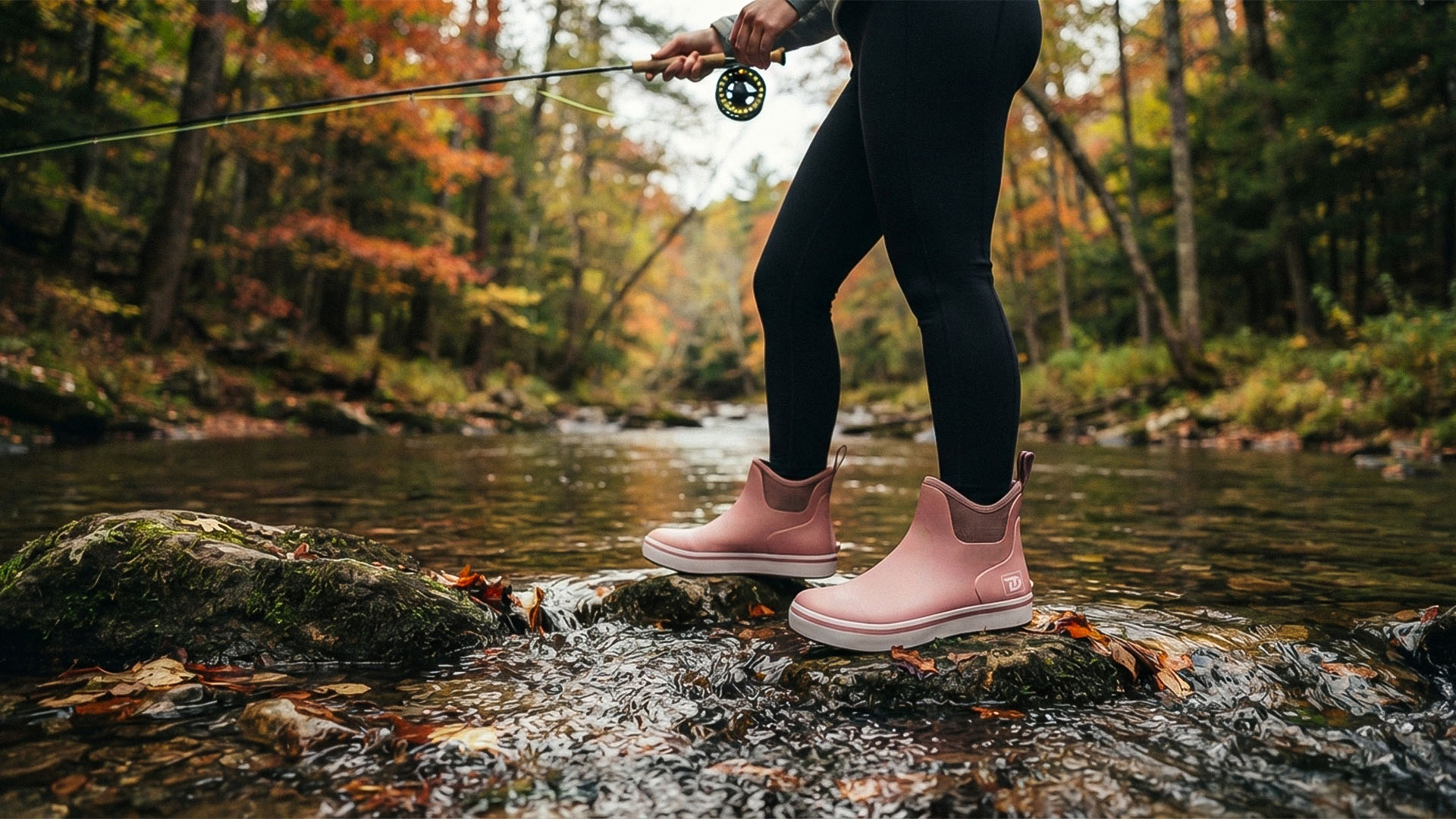
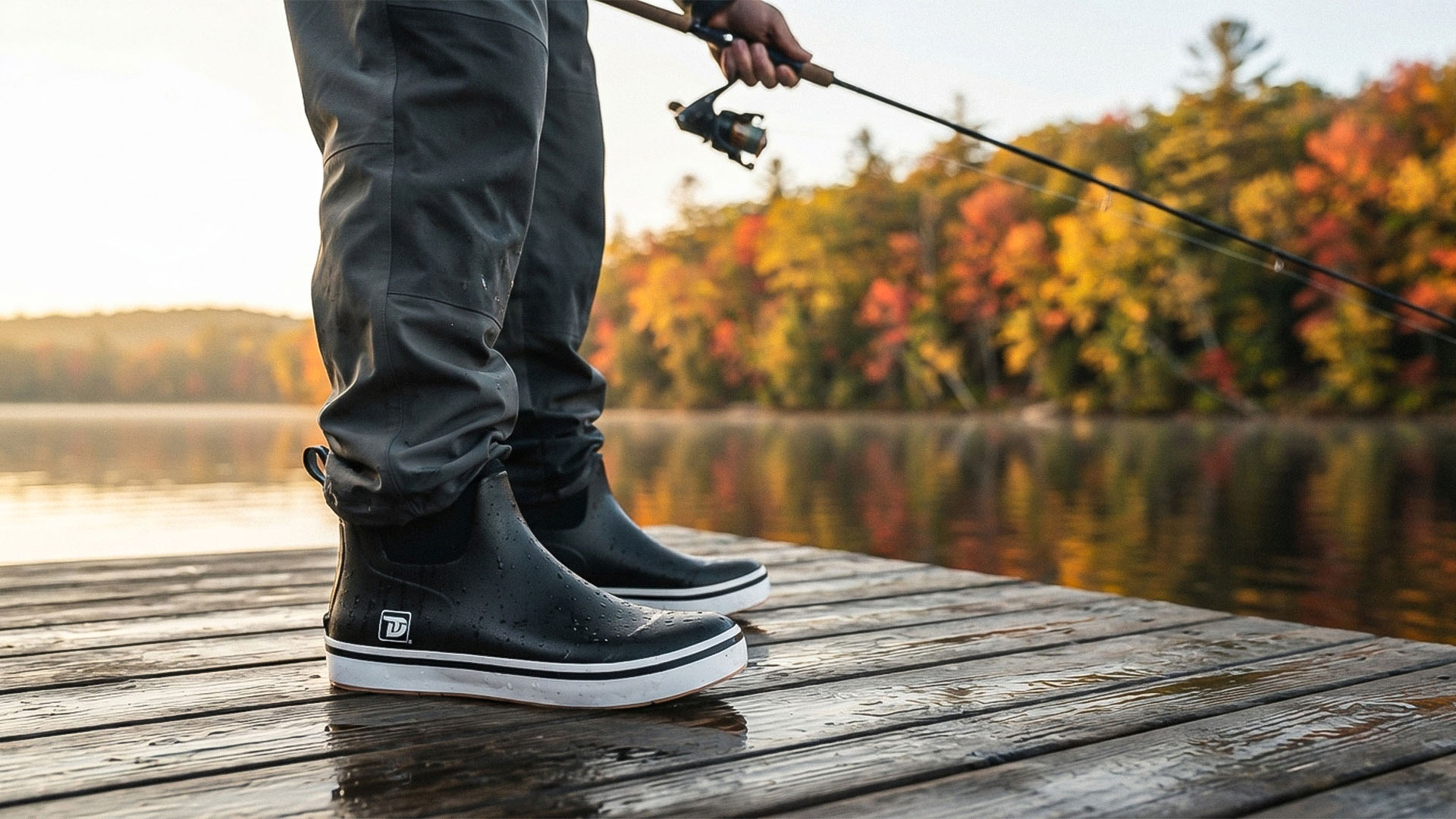
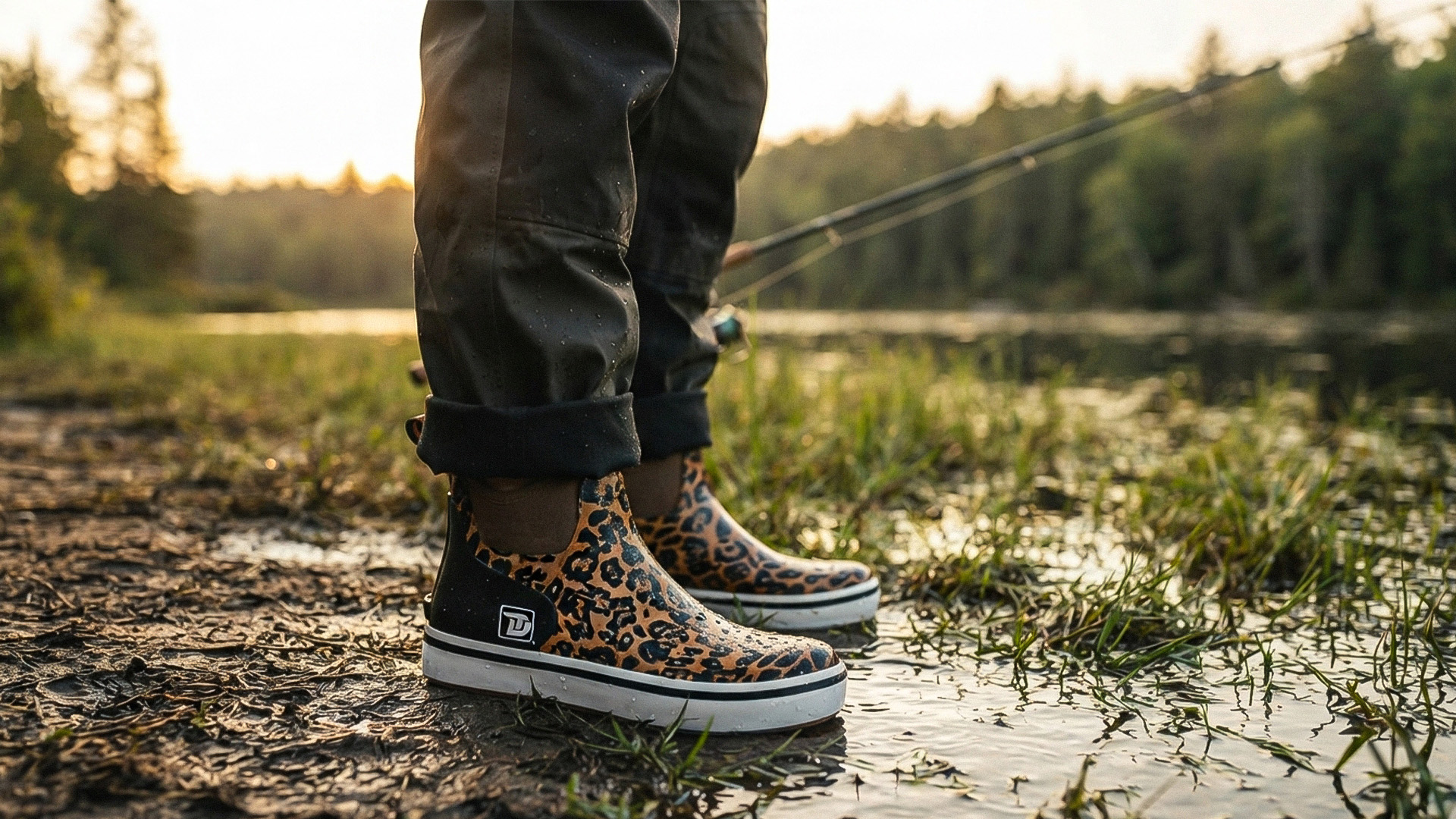
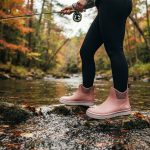
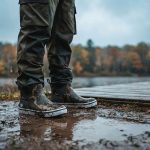
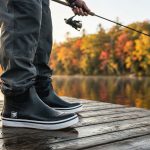
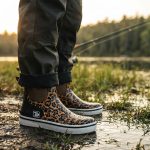
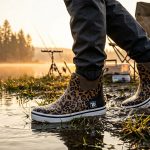
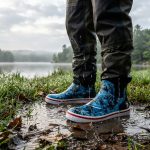
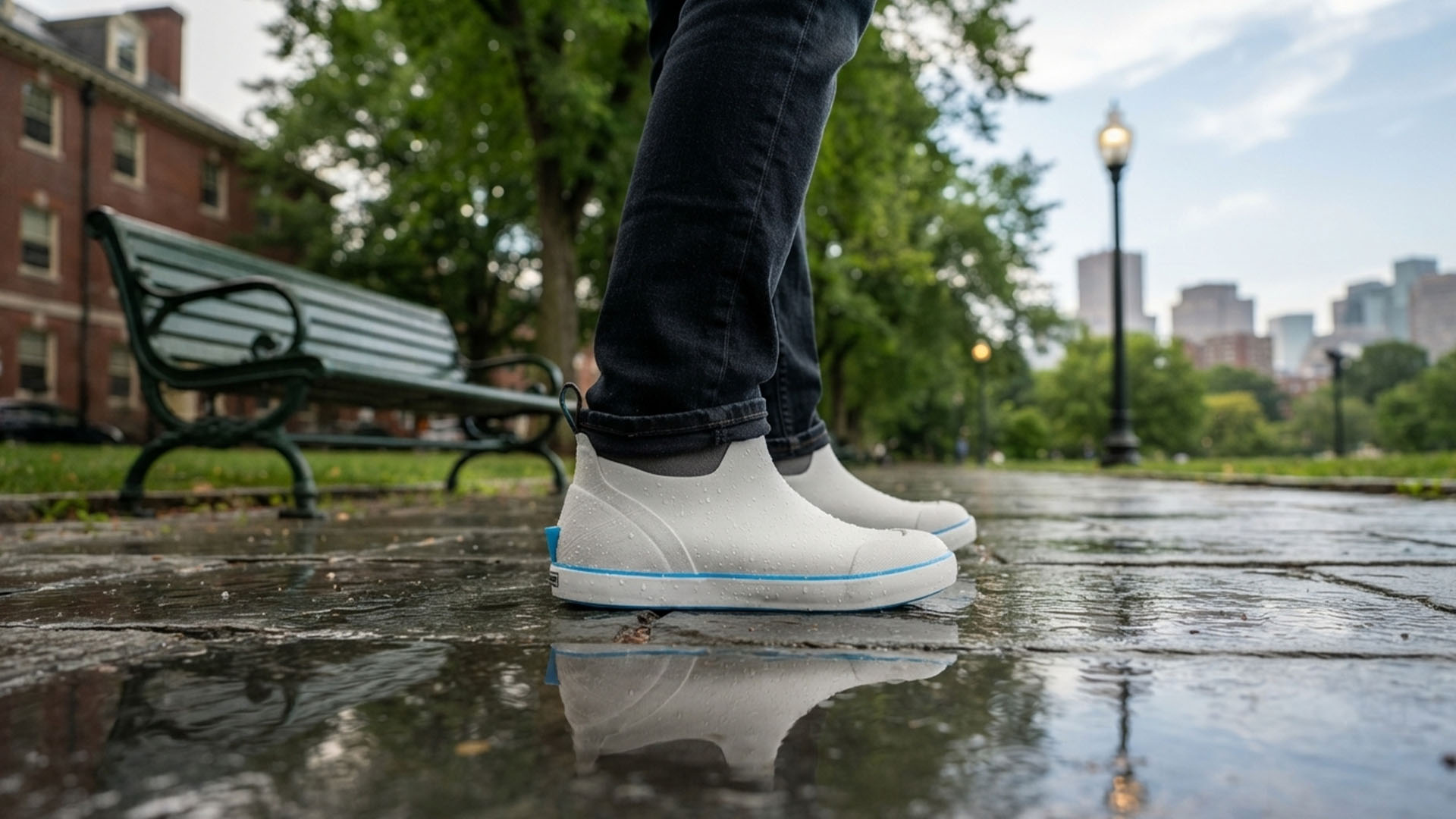
Ankle deck boots work well around shallow mud, wet grass, maintained banks, docks, and boat ramps.
They become less effective when the ground is soft enough for the foot to sink several inches.
Understanding the terrain before choosing footwear is the first step.
Choose Boot Height Based on Mud Depth
Boot height should match the deepest mud and water you expect to encounter.
Ankle Deck Boots
Best for:
- Wet grass
- Shallow mud
- Maintained pond banks
- Concrete boat ramps
- Light rain
- Short walks from the vehicle
- Firm shorelines with occasional puddles
Ankle deck boots are lightweight, easy to clean, and comfortable for short approaches.
Their main limitation is the low opening.
Mud can enter when the foot sinks deeply or when wet soil falls from the lower leg.
Mid-Calf Rubber Boots
Best for:
- Moderate mud
- Wet fields
- Marsh edges
- Deeper puddles
- Tall grass
- Soft reservoir banks
Mid-calf boots provide more coverage without the full bulk of knee-high footwear.
Tall Rubber or Muck-Style Boots
Best for:
- Deep mud
- Farm ponds
- Marshes
- Flooded shorelines
- Heavy rain
- Thick vegetation
- Repeated water crossings
Tall boots provide the most lower-leg protection.
They can also feel heavier, warmer, and more restrictive.
Use the lowest boot that safely handles the actual conditions.
Do Not Tuck Loose Pants Deep Inside Short Boots
Tucking pants into ankle boots may seem like a way to keep the fabric clean.
In practice, it can direct mud, rain, grass, and debris into the opening.
Loose pants collect material as you walk.
That material moves downward and may fall directly into the boot.
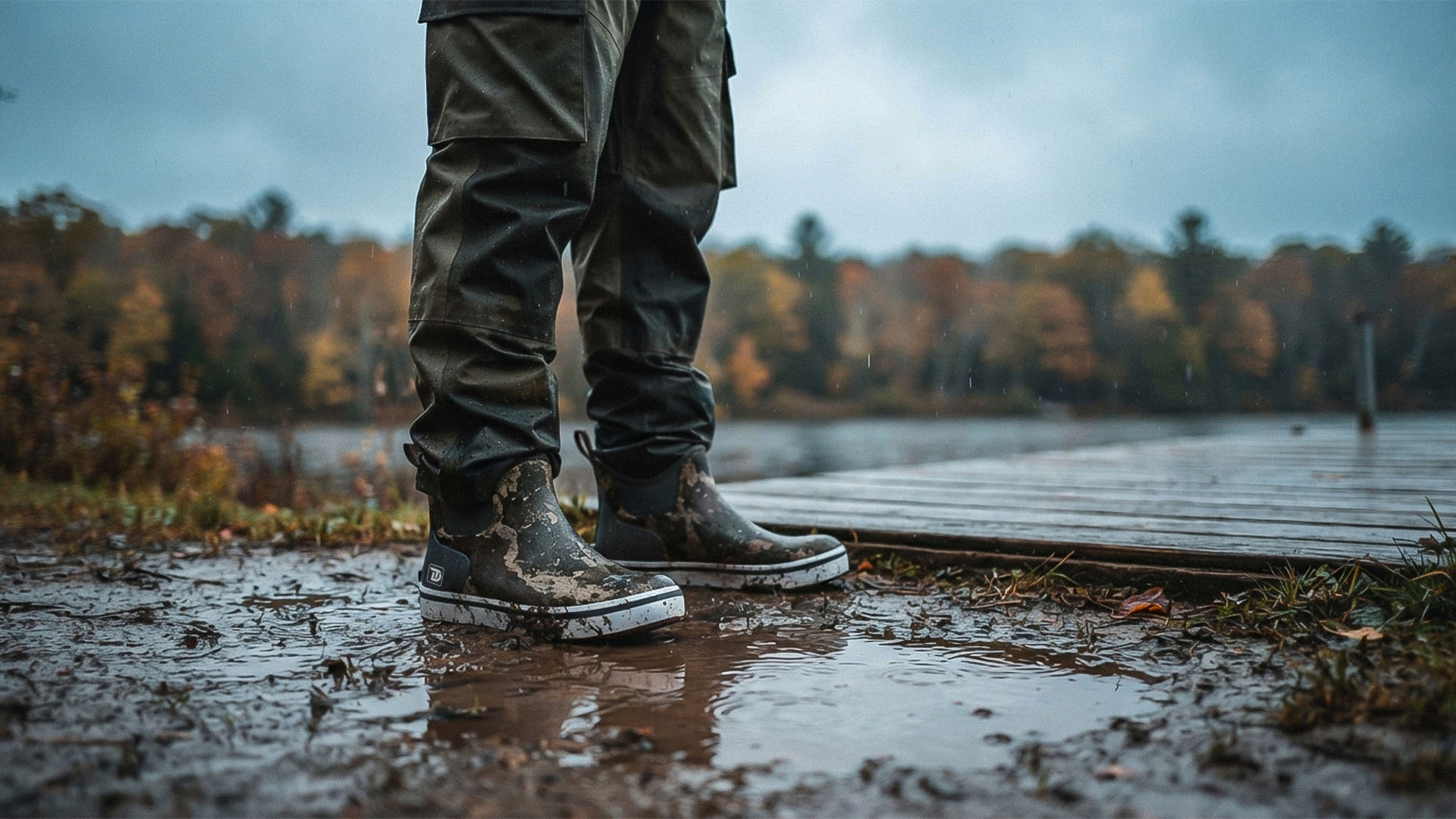
For shallow mud and rain, allow waterproof or quick-drying pants to overlap the outside of the boot opening.
This creates a barrier that helps direct water and loose material away from the interior.
Make sure the pant leg is not so long that it drags through the mud.
When Should You Tuck Pants Into Boots?
Tucking pants into taller boots may be useful when:
- The boots extend well above the ankle
- Tall grass is the main problem
- Ticks or insects are a concern
- The pant fabric is fitted closely
- The ground is wet but not deep enough to reach the opening
- The clothing system is designed for tucked use
The goal is to prevent loose fabric from collecting mud while avoiding a direct funnel into the footwear.
With ankle-height boots, overlapping pants are usually more effective.
With tall boots, tucking fitted pants may work when conditions require it.
Use Fishing Gaiters
Gaiters create a protective layer between the lower pant leg and the boot.
They are commonly used by hikers, hunters, trail workers, and anglers moving through wet vegetation and loose terrain.
A gaiter can help keep out:
- Mud
- Sand
- Small rocks
- Grass seeds
- Twigs
- Rain
- Snow
- Shoreline debris
Short ankle gaiters may be enough for maintained banks and gravel.
Tall gaiters provide more protection around deep mud, brush, and wet grass.
Choose gaiters that fit securely around the boot without interfering with walking.
What Features Should Fishing Gaiters Have?
Useful gaiter features include:
- Water-resistant or waterproof fabric
- Secure upper closure
- Adjustable lower strap
- Hook attachment for laces when applicable
- Close fit around the boot
- Durable lower panels
- Easy-to-clean construction
Deck boots do not always have laces for a gaiter hook.
Make sure the gaiter design works with slip-on footwear.
Some gaiters fit better with hiking boots than ankle deck boots.
Test the combination before a full fishing trip.
Use Pants With Adjustable Cuffs
Fishing pants with adjustable cuffs can help reduce the amount of material entering the boots.
Useful cuff designs include:
- Elastic openings
- Snap closures
- Hook-and-loop adjustments
- Drawcords
- Tapered lower legs
The cuff should fit close enough to control loose fabric but not so tight that it restricts movement.
For rain, the pant leg should still direct water outside the boot.
Avoid long, wide cuffs that drag across the ground.
Choose Boots With a Closer Collar
Some pull-on boots have very wide openings.
This makes them easy to put on, but it also allows more debris inside.
A closer-fitting collar can reduce entry while still allowing comfortable movement.
Look for:
- Shaped ankle openings
- Flexible collars
- Secure heel fit
- Minimal gaps around the lower leg
- Pull tabs that do not require an oversized opening
The collar should not rub or restrict circulation.
Boots should remain easy to remove after hours of standing.
Check the Fit Around the Heel
Loose boots move more in mud.
When the foot sinks, suction may hold the boot while the heel lifts inside.
This movement can allow the boot opening to shift and collect more dirt.
A secure fit helps the boot move with the foot.
Look for:
- Minimal heel lift
- Stable midfoot contact
- Correct width
- Supportive insole
- Enough toe room without excessive length
Anglers comparing low-profile waterproof footwear can review [TruDaveGear deck boots] alongside other fishing-specific options while considering whether the opening and heel shape match the terrain.
For deep mud, a taller boot may remain the better choice regardless of fit.
Avoid Boots That Are Too Large
Oversized boots are more likely to:
- Twist in soft mud
- Pull away from the foot
- Create heel friction
- Allow debris inside
- Feel unstable on slopes
- Become stuck during deep steps
Do not use very thick socks to correct a boot that is much too large.
That may increase heat and moisture without improving control.
Choose the correct size and width.
Use the Right Socks
Socks cannot stop mud from entering, but they can reduce the discomfort caused by small amounts of moisture and debris.
Good bank-fishing socks should:
- Fit securely
- Extend above the boot opening
- Manage moisture
- Resist bunching
- Dry faster than cotton
- Provide cushioning around the heel
Synthetic or merino wool socks are generally better than cotton.
Cotton absorbs water and dries slowly.
Crew-length or boot-length socks provide better ankle coverage than low-cut socks.
Consider a Sock Liner
A thin sock liner may help during long walks.
It sits close to the skin and can reduce friction when the outer sock becomes damp.
A liner may be useful for:
- Long bank-fishing approaches
- Warm conditions
- Anglers prone to blisters
- Loose debris inside the boot
- Extended standing
The boot must have enough room for two layers.
A tight two-sock system can restrict circulation.
Carry Spare Socks
Even a good clothing system can fail in deep mud or heavy rain.
Keep one or two dry pairs of socks in a waterproof bag.
If mud or water enters the boots:
- Remove the footwear.
- Empty loose material.
- Wipe or rinse the interior when possible.
- Dry the feet.
- Change into clean socks.
- Avoid putting dry socks into boots containing standing water.
Spare socks take very little room and can save the rest of the trip.
Scout the Bank Before Stepping Down
Many muddy problems begin because anglers step into soft ground without checking it.
Before moving toward the shoreline:
- Look for darker soil
- Watch for standing water
- Check footprints from other anglers
- Notice areas where grass has flattened
- Use a stick to test soft ground
- Look for firmer gravel or vegetation
- Avoid steep clay sections
A slightly longer route across firm ground may be better than the direct muddy path.
Watch Other Footprints
Existing footprints can reveal ground conditions.
Deep impressions may indicate soft mud.
Water-filled tracks often show that the surface has poor drainage.
However, do not automatically step inside someone else’s footprints.
The bottom may be deeper or softer than expected.
Use them as a warning rather than a guaranteed path.
Step on Firmer Ground When Possible
Firm surfaces may include:
- Gravel
- Roots
- Dense grass
- Flat stones
- Compacted soil
- Established paths
- Wooden access structures
Avoid stepping on unstable rocks or wet logs simply to stay out of mud.
A cleaner route is not worth a fall.
Choose the safest firm surface available.
Take Short, Controlled Steps
Long steps place more pressure on the leading foot.
This can cause it to sink deeper.
Shorter steps help distribute weight and make it easier to test the surface before committing.
Keep your knees slightly bent.
Avoid sudden turns while one foot is stuck.
Move slowly when carrying heavy gear.
Lift Your Foot Straight Up
When pulling a boot from mud, lift the foot as vertically as possible.
Twisting aggressively can cause:
- Heel movement
- Boot loss
- Ankle strain
- Mud entering the opening
- Balance problems
Deep mud creates suction.
Move slowly and allow air to enter around the boot.
Use a stable object or fishing partner for support when necessary.
Do Not Pull Too Hard Against Suction
If the boot feels stuck:
- Stop moving forward.
- Shift weight to the other foot.
- Move the trapped foot slightly side to side.
- Lift gradually.
- Avoid leaning backward suddenly.
- Keep fishing gear balanced.
Trying to force the foot out quickly may leave the boot behind.
It may also cause a fall.
Use a Walking Stick or Bank Pole
A walking stick can help test mud depth and improve balance.
It is useful on:
- Steep banks
- Soft shorelines
- Marsh edges
- Slippery clay
- Rocky approaches
- Water crossings
Do not use an expensive fishing rod as a walking support.
Rods are not designed to carry body weight and may break.
Use a dedicated staff or sturdy stick.
Make More Than One Trip With Gear
Carrying too much equipment reduces your ability to balance and choose careful steps.
Instead of carrying rods, cooler, chair, tackle, and bait in one trip, make multiple trips when the bank is difficult.
Keep at least one hand free when possible.
A backpack-style tackle bag can also help distribute weight.
Use Gear With Shoulder Straps
Hands-free gear makes it easier to manage muddy terrain.
Useful options include:
- Tackle backpack
- Rod sling
- Shoulder cooler
- Folding chair with strap
- Waist pack
Secure all hooks, tools, and sharp objects before walking.
Falling while carrying exposed hooks can cause serious injury.
Avoid Steep Muddy Clay
Clay banks become extremely slippery when wet.
Even aggressive footwear may provide limited traction.
If the bank is steep and saturated:
- Find another access point
- Fish from higher ground
- Use steps or established paths
- Avoid carrying heavy gear down the slope
- Do not rely entirely on boot tread
No fishing spot is worth an avoidable fall.
Be Careful Around Algae and Shoreline Slime
Mud is not the only hazard.
Wet rocks, concrete ramps, and logs may be covered with algae.
A boot designed for mud may still slide on a smooth contaminated surface.
Move carefully where the bank meets the water.
Avoid stepping on surfaces you cannot clearly evaluate.
How to Keep Sand Out of Fishing Boots
Sand enters easily through ankle openings.
To reduce sand:
- Use gaiters
- Wear pants over the collar
- Avoid loose low-cut socks
- Choose a closer boot opening
- Walk around deep dry sand when possible
- Remove sand before it reaches the insole
Fine sand creates friction quickly.
Stop and empty the boots before it causes blisters.
How to Keep Grass and Seeds Out
Tall grass can drop seeds, burrs, and small insects into footwear.
Use:
- Long pants
- Adjustable cuffs
- Gaiters
- Taller boots
- Closely fitting socks
- Insect precautions appropriate for the region
Check clothing and footwear after leaving tall vegetation.
Do not carry invasive seeds or plant material to another fishing location.
How to Keep Rain From Running Into Boots
Rain often enters from above.
Use waterproof pants that overlap the outside of the boots.
Make sure:
- Pant legs are long enough
- Cuffs remain over the opening
- Fabric does not ride up when bending
- Rain jackets overlap the pants
- Water does not collect around the waist
Avoid tucking rain pants into short boots during heavy rain.
That creates a direct path for water.
What to Do When Water Gets Inside
Once water enters waterproof boots, it may remain trapped.
If practical:
- Move to stable ground.
- Remove the boots.
- Drain the water.
- Remove mud and debris.
- Dry your feet.
- Replace wet socks.
- Clean the insole.
- Adjust pants or gaiters before continuing.
Do not ignore wet feet during a long trip.
Moisture and friction can lead to blisters and skin irritation.
Use Waterproof Bags for Dry Gear
Store backup socks and clothing in:
- Dry bags
- Waterproof pouches
- Resealable plastic bags
- Sealed compartments
Do not assume a tackle backpack is fully waterproof.
Keep wet socks separate from dry clothing.
Should You Use Waders for Muddy Banks?
Waders may be appropriate when:
- Water is above boot height
- The shoreline requires wading
- Mud is mixed with shallow water
- Cold-water protection is needed
- The fishing method requires standing in the water
They may be unnecessary for ordinary bank fishing.
Waders are heavier, warmer, and require additional safety precautions.
Use the lightest appropriate protection for the conditions.
Deck Boots or Tall Boots for Mud?
Choose ankle deck boots when:
- Mud is shallow
- The surface is flat
- Walking distance is short
- Mobility matters
- You also use docks or boats
- Easy cleaning is important
Choose tall boots when:
- Mud is deep
- Grass is tall
- Puddles are frequent
- The shoreline is marshy
- Water reaches above the ankle
- Lower-leg coverage matters
Choose hiking boots when:
- Terrain is rocky
- The bank is steep
- Walking distance is long
- Support matters more than waterproof height
How to Clean Muddy Fishing Boots
Clean mud before it hardens completely.
Step 1: Remove Loose Mud
Use a hose, brush, or stick outdoors.
Do not wash heavy mud into indoor plumbing.
Step 2: Rinse With Fresh Water
Rinse the upper, outsole, tread, and boot opening.
Step 3: Use Mild Soap
Apply mild soap when mud contains organic residue, fish slime, or strong odors.
Step 4: Clean the Tread
Mud packed inside outsole grooves can reduce traction.
Use a separate brush.
Step 5: Clean the Interior
If mud entered the boot, remove the insole and follow the manufacturer’s cleaning instructions.
Step 6: Dry Completely
Use airflow in a shaded location.
Avoid clothes dryers, heaters, and excessive heat.
Why Tread Cleaning Matters
Mud left in the outsole can become a problem when you move onto:
- Concrete
- Wood docks
- Boat decks
- Vehicle pedals
- Indoor floors
A mud-focused tread may lose grip when the grooves are completely packed.
Clean the boots before moving from soft terrain to hard surfaces.
How to Dry Boots After Muddy Fishing
Remove insoles and loose debris.
Drain any water.
Place the boots in a ventilated area.
Use a low-temperature or no-heat boot dryer when compatible with the materials.
Do not store wet boots inside:
- Vehicle trunks
- Boat lockers
- Sealed tubs
- Gear bags
- Closets without airflow
Mud and moisture can create strong odors.
Inspect Boots After Difficult Trips
After walking through deep mud, check for:
- Small punctures
- Cracks
- Outsole separation
- Embedded stones
- Hooks
- Damaged pull tabs
- Worn tread
- Interior debris
Sharp objects may remain hidden in mud.
Remove them carefully.
Wear gloves when inspecting tread that may contain hooks or metal.
Common Mistakes That Let Mud Into Boots
Wearing Boots That Are Too Short
Ankle boots cannot handle deep mud.
Tucking Loose Pants Into the Opening
Mud and water can travel down the fabric.
Ignoring Gaiters
A simple gaiter can block significant debris.
Wearing Boots That Are Too Large
Loose footwear shifts and opens gaps around the ankle.
Taking Long Steps
Long steps increase sinking.
Carrying Too Much Gear
Poor balance makes careful foot placement difficult.
Walking Straight Through the Softest Area
Scout for a firmer route.
Waiting Too Long to Remove Debris
Sand and mud create friction quickly.
Bank Fishing Mud-Protection Checklist
Before leaving home, pack:
- Appropriate-height boots
- Quick-drying fishing pants
- Gaiters when needed
- Moisture-wicking socks
- Spare socks
- Waterproof dry bag
- Small towel
- Boot brush
- Extra footwear for the drive home
- Walking stick for difficult banks
Before stepping onto the bank:
- Check mud depth
- Look for firm access
- Secure fishing gear
- Adjust pants
- Close gaiters
- Keep one hand free
After fishing:
- Remove loose mud
- Clean the tread
- Rinse the boots
- Remove the insoles
- Dry everything fully
Final Thoughts
Keeping mud out of fishing boots begins before you step onto the bank.
Choose boot height according to mud depth.
Use ankle deck boots for wet grass, shallow mud, maintained shorelines, docks, and short approaches.
Use taller boots when water and mud regularly rise above the ankle.
Wear pants that overlap short boots instead of directing debris into the opening.
Use gaiters when sand, grass, mud, and loose material are common.
Make sure the boots fit securely.
Take short steps.
Test soft ground.
Carry less gear at one time.
Keep spare socks in waterproof storage.
No system will keep every grain of sand or drop of water out during difficult conditions.
The goal is to reduce how much enters, address the problem early, and choose footwear that matches the shoreline.
A little preparation can prevent a muddy bank from turning the rest of your fishing trip into several hours of wet socks and uncomfortable feet.
Frequently Asked Questions
How do I stop mud from getting inside fishing boots?
Choose boots tall enough for the terrain, wear pants over short boot openings, use gaiters, ensure a secure fit, and avoid stepping into mud deeper than the footwear.
Should fishing pants go inside or outside boots?
For ankle deck boots, pants should usually overlap the outside so mud and rain move away from the opening. Fitted pants may be tucked into tall boots in certain conditions.
Are ankle deck boots good for muddy bank fishing?
They work well for shallow mud, wet grass, maintained banks, and short approaches. Tall boots are better when mud regularly rises above the ankle.
Do gaiters work with fishing boots?
Yes, provided the gaiters fit the boot style securely. They can help block mud, sand, rain, grass seeds, and shoreline debris.
What boots are best for deep mud?
Tall rubber or muck-style boots usually provide better coverage. Waders may be necessary when deep mud is combined with water above boot height.
How do you walk through deep mud without losing a boot?
Take short steps, lift the foot vertically, move slowly, reduce suction with gentle side-to-side movement, and make sure the boots fit securely.
How do I keep sand out of ankle boots?
Use short gaiters, wear pants over the boot collar, choose a closer opening, and remove sand quickly before it causes friction.
What socks are best for muddy fishing?
Synthetic or merino wool socks are better than cotton because they manage moisture and dry faster. Choose crew-length socks that extend above the boot opening.
How do you clean mud from fishing boot tread?
Rinse the outsole with fresh water and use a brush to remove packed mud from the grooves. Clean the tread before walking onto hard surfaces.
Should I bring spare shoes for bank fishing?
Yes. Keeping clean footwear in the vehicle protects the interior and gives you a dry option after muddy or wet fishing.